
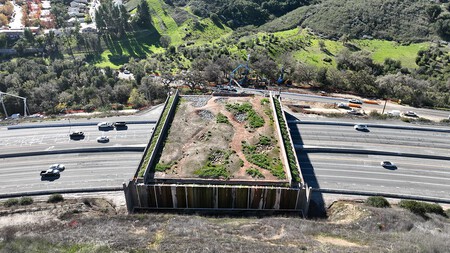
The Need for Wildlife Crossings
While for humanity, roads are essential means of communication, for animals, they often serve as lethal barriers. Each year, millions of animals die attempting to cross roads that fragment their habitats. This challenge is not unique to California; similar issues are witnessed globally, from the endangered Asian cheetah in Iran to the elephants in India, which face dangers not only from vehicles but also from railways.
Introducing Wildlife Steps
One innovative solution proposed by conservation biology is the establishment of wildlife crossings—structures such as bridges, tunnels, or walkways that facilitate safe animal movement across roads or railways. California is elevating this concept with the construction of the Wallis Annenberg Wildlife Crossing, the largest wildlife crossing ever built.
The Wallis Annenberg Wildlife Crossing
Located in Agoura Hills, Los Angeles, this monumental bridge spans 64 meters and crosses the busy US-101 highway. Composed of over 11.8 million kilograms of concrete and 82 bridge beams, the crossing incorporates more than 6,000 cubic meters of living soil. This soil will sustain 50 species of native plants, replicating the region’s coastal sage scrub ecosystem, which is crucial for local wildlife.
The project is a collaborative effort that began on Earth Day 2022 and has a hefty price tag of $114 million. Set to be inaugurated this autumn, it represents a significant stride in wildlife conservation.
Importance of the Crossing
The National Park Service has identified a pressing issue: mountain lions in the Santa Monica Mountains are genetically isolated due to extensive urbanization and roads. This isolation restricts genetic exchange, fostering inbreeding and loss of genetic variability, effectively trapping these species in a cycle of decline.
However, the bridge will benefit not only the mountain lions but also numerous species such as red lynxes, foxes, coyotes, and various reptiles. This initiative aligns with California’s 30×30 objective, which aims to conserve 30% of the state’s coastal lands and waters before 2030, reinforcing connections between protected areas.
Contextualizing Wildlife Crossings
Wildlife passages aren’t a novel idea; the concept dates back to the 1950s in France, and Europe has been refining these structures for decades. What sets the Wallis Annenberg Crossing apart is its scale and urban location, traversing a 10-lane highway that sees over 300,000 vehicles daily.
Other successful crossings, like Colorado’s Greenland Wildlife Overpass, have shown promising results, indicating that similar structures can drastically reduce animal mortality rates by up to 90%.
Global Comparisons
Despite being the largest in the world, the Wallis Annenberg Wildlife Crossing isn’t the only ambitious project. Notable examples include:
- Natuurbrug Zanderij Crailoo in the Netherlands: The longest ecoduct globally, measuring 800 meters.
- Doñana National Park in Spain: Features a network of crossings for the endangered Iberian lynx.
- Various crossings in Poland and Turkey have demonstrated similar successes in protecting wildlife.
Addressing Cost and Effectiveness
Despite the ecological importance of the Wallis Annenberg Wildlife Crossing, critics voice concerns over its cost. Initially budgeted at $92 million, the project is now projected to cost $114 million. Additionally, some argue that this single large infrastructure may not be sufficient to remedy the genetic isolation of a population—suggesting that a series of smaller interventions might be more effective.
Future Monitoring
Scientific data on wildlife crossings reveal mixed results. A study published in the Journal of Applied Ecology noted that while crossings might be used frequently, their actual impact on population viability is harder to quantify. Design and location are critical factors; smaller structures (<20 meters) may see less usage and effectiveness. Long-term monitoring of the Wallis Annenberg Crossing will be crucial to ascertain its true impact on local wildlife populations.
Conclusion
The Wallis Annenberg Wildlife Crossing represents a groundbreaking investment in biodiversity conservation, linking fragmented ecosystems and supporting genetic diversity among species. While the endeavor is not without its challenges and critiques, its successful implementation may pave the way for future wildlife friendly infrastructures, heralding a promising new chapter in conservation efforts for California and beyond.