
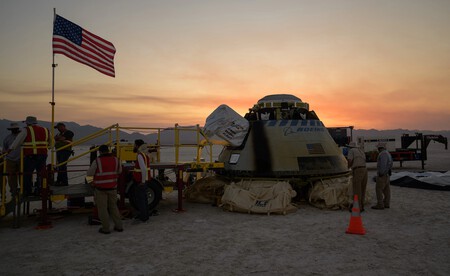
Starliner: Boeing’s Pivotal Journey in Manned Spaceflight
For years, Starliner was positioned as Boeing’s opportunity to claim a significant role in American manned flights, especially as SpaceX rapidly advanced with its Dragon spacecraft. The contract signed with NASA in 2014 heralded a promising future: six manned flights envisioned as a gateway to new missions. However, eleven years later, circumstances have altered dramatically. The agreement has been revised, and the upcoming mission has transitioned into a non-crewed test flight.
Revised Contract with NASA
This agreement once ensured that Starliner was a crucial part of NASA’s plan, which aimed to guarantee at least two different US vehicles for International Space Station (ISS) transportation. The primary goal was clear: establish redundant systems for astronaut transport, ensuring long-term planning and operational autonomy in low Earth orbit. Initially, it was stipulated that Boeing would conduct six manned flights following the spacecraft’s certification, all while keeping an eye on the ISS’s operational timeline set for 2030.
Contract Modification Details: Recently, NASA and Boeing mutually agreed to modify the existing contract. The number of guaranteed flights has been cut back significantly. Instead of the previously planned six manned missions post-certification, the new plan includes a mission without crew aimed at system validation and will allow for up to three crewed rotations. Furthermore, two optional flights might be activated based on NASA’s mission requirements. This adjustment has also resulted in a hefty reduction in the contract’s value from $4.5 billion to $3.732 billion, a decrease of $768 million.
Starliner-1: Validation Mission
Dubbed Starliner-1, this uncrewed mission is fundamental to validating the system’s performance. NASA plans to use it to transport cargo to the ISS, testing the modifications made after the planned manned flight in 2024. The target launch date now stands at no earlier than April 2026, contingent upon rigorous testing and certification processes leading up to launch.
Challenges and Setbacks
Starliner’s journey thus far has not been without complications. Early warning signs appeared with the Operational Flight Test-1 (OFT-1) flight in December 2019, where Starliner failed to complete its planned profile, necessitating an early termination. By 2022, the OFT-2 mission reached the ISS but encountered several thruster malfunctions. The troubles continued during the first manned flight, leading NASA to pull the astronauts back despite the spacecraft nearing the ISS.
Comparative Success: SpaceX Dragon
While Boeing faced these hurdles, SpaceX’s Dragon spacecraft has operated smoothly, beginning crewed missions in 2020. The Dragon has fully integrated into NASA’s operations, efficiently executing the scheduled rotations under the Commercial Crew Program. As of August 2025, the Crew-11 mission was successfully completed, while Crew-12 is slated for February 2026. NASA has scheduled additional Dragon flights through the ISS’s operational life until 2030.
Implications of Contract Changes
The modification in the contract signifies a shift in Boeing’s stature within the program. The reduced financial investment to $3.732 billion, alongside fewer guaranteed flights, puts additional pressure on Boeing to ensure Starliner’s reliability in future missions. With over $2 billion already invested since 2016, the stakes are significantly high for the upcoming flights. Nevertheless, Boeing remains committed to the program and suggests that opportunities might arise for Starliner in commercial endeavors post-ISS operations.
Looking Ahead
The future trajectory of the Starliner project heavily depends on the outcome of its next scheduled flights. If the craft secures certification by 2026, it could still engage in up to three crewed rotations, supplemented by two optional flights subject to NASA’s evaluation. Although the comprehensive vision from 2014 may be altered, the potential for Starliner remains, albeit in a revised context.