
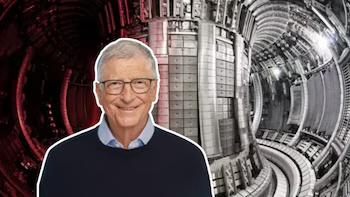
Bill Gates Secures Approval for a New Nuclear Reactor
Business magnate and philanthropist Bill Gates has achieved an important milestone by securing approval from the Nuclear Regulatory Commission (NRC) for the construction of a cutting-edge nuclear reactor in the United States. This initiative, led by Gates’ company TerraPower, centers around the innovative use of liquid sodium cooling technology, a promising advancement in nuclear reactor design.
The Natrium Reactor: A Game Changer
The approved project will see the construction of the Natrium reactor at the Kemmerer Unit 1 facility in Wyoming. Notably, this marks the first time a U.S. regulatory authority has approved a nuclear plant employing such advanced technology. The Natrium reactor is designed with a base power output of 345 megawatts, with an energy storage system capable of enhancing output to 500 megawatts during peak demand.
Transitioning from Coal
This new reactor is part of a broader strategy aimed at replacing coal-fired plants with cleaner, more reliable energy sources. The Natrium plant will be built adjacent to a coal facility whose operations are nearing closure, allowing the existing infrastructure to be repurposed to maintain regional electricity supply.
Advantages of Liquid Sodium Cooling Technology
The Natrium design distinguishes itself by utilizing liquid sodium as a coolant instead of the traditional pressurized water. This innovative approach enables operations at significantly lower pressures, thereby reducing risks associated with potential cooling system failures.

Cost Efficiency and Compact Design
Utilizing liquid sodium not only increases safety but also leads to a more compact reactor design, which may reduce construction costs compared to conventional nuclear plants. Additionally, the integrated thermal storage system using molten salts allows for energy to be stored during low demand periods and released later, enhancing operational flexibility—a critical factor that has historically limited nuclear energy’s competitiveness.
Fuel Challenges and Supply Security
One significant challenge associated with the Natrium reactor is its fuel requirements. The system relies on a special type of uranium known as HALEU (high-assay, low-enriched uranium), which has previously been sourced primarily from Russia. To mitigate this risk, the U.S. Department of Energy is working to establish a domestic supply chain for HALEU, ensuring the nation’s energy independence in nuclear fuel.
Meeting Growing Energy Demands
The push for new nuclear reactors aligns with a global shift in energy demands, particularly due to the rising electricity consumption associated with artificial intelligence and data centers. Major tech firms like Google and Microsoft are reported to consume approximately 24 terawatt-hours of energy in 2023—a consumption level comparable to that of several mid-sized nations.

Conclusion: Nuclear Power for a Sustainable Future
The development of the Natrium reactor signals a significant evolution in the nuclear energy landscape. With its liquid sodium cooling technology and innovative design, it aims to meet the growing demand for energy while reducing emissions. Unlike renewable sources dependent on weather conditions, nuclear power stands out for its 24/7 operational capacity, making it a key player in the future of stable and sustainable energy generation.