
The race for artificial intelligence dominance among major tech companies has escalated into a frantic competition, marked by enormous investments in infrastructure. This drive incorporates the construction of data centers , acquisition of chips, and expansion of computational capabilities. According to experts, these spending patterns mirror the exorbitant investments seen during previous market bubbles.
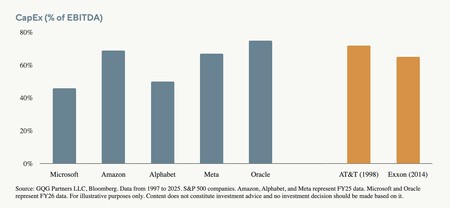
Echoes of the Dot-Com Bubble. Tech giants are currently channeling between 50% and 70% of their EBITDA (Earnings Before Interest, Taxes, Depreciation, and Amortization) into capital expenditures, mostly related to AI and cloud infrastructure. This observation comes from an analysis by GQG Partners. Historically, such levels of investment are reminiscent of AT&T’s behavior during the dot-com bubble, which allocated 72% of its earnings to fixed asset investments, similar to what Exxon did during the energy bubble in 2014 at 65% .
Percentage of operational benefit that Big Tech are spending against the level of AT&T and Exxon before bubbles. Image: GQG Partners
Concerns Unfolding. GQG Partners and analysts like Tobias Carlisle, founder of Acquirer’s Funds, warn that such high spending is often a red flag. The concerns center around the risk of obsolete assets , delayed returns, and significant ongoing expenditures without guaranteed immediate benefits. The graph detailing the percentages of operational benefits spurred into fixed assets (CAPEX) by companies like Microsoft , Amazon , Alphabet , Meta , and Oracle elucidates this trend.
Investment Details. Current market dynamics reveal a strong investor appetite, compelling companies to adjust their forecasts dramatically. Alphabet , for instance, plans to spend over $85 billion this year, primarily fortifying its cloud services. Meta is preparing to invest between $66 billion and $72 billion in 2025, projecting a massive investment of $600 billion by 2028. Likewise, Microsoft has earmarked tens of billions for new facilities aimed at expediting AI model training. The Financial Times anticipates the annual capital expenditure of major tech companies to surpass $300 billion , marking an unprecedented figure in the industry.

However, this level of investment raises eyebrows among analysts. Goldman Sachs recently sounded the alarm regarding hyperscalers like AWS, Microsoft Azure, and Google Cloud, pointing out that they have collectively committed hundreds of billions in Capex and R&D. For these firms to justify such investments, they must generate significantly higher revenues in the upcoming years. Conversely, Bank of America cautions that the depreciation and amortization costs of this infrastructure could escalate even faster than the income generated, risking their operational margins.
Analysts at Morningstar caution that the semiconductor industry , which serves as a pivotal element in this race, is prone to cyclical booms and busts. They predict a potential cooling off from the current investment enthusiasm into 2025-2026 . Notably, Sam Altman, CEO of OpenAI, has publicly acknowledged a “bubble” surrounding artificial intelligence, yet he maintains that the underlying technology holds immense long-term value .
Potential Risks Ahead. Investing heavily in infrastructure does not automatically translate to future income that compensates such high expenses. While optimistic investor sentiment may sustain current capital raises, doubt and uncertainty could upend this trend. The GQG Partners analysis also highlights potential “hidden” costs such as accelerated depreciation, technological obsolescence, and the maintenance and energy consumption of data centers—factors that may erode profit margins faster than anticipated.
The tech industry is embarking on a dramatic phase of investment in AI and infrastructure—marked by both exhilaration and trepidation. As companies forge ahead, balancing capital expenditures against market realities will be paramount in determining the sustainability and profitability of their ambitious ventures. Continuous monitoring of these developments will be essential for investors and stakeholders alike, as they navigate the complexities of a rapidly evolving technological landscape.