
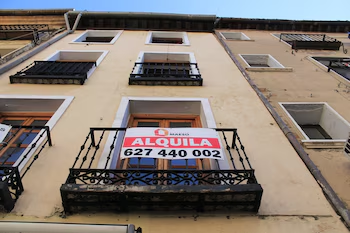
Constitutional Court to Review Catalonia’s Rental Regulations
The Constitutional Court (TC) of Spain has taken a significant step by agreeing to process an appeal from the Popular Party (PP) against several articles of the Catalan housing and urban planning law, which aims to regulate seasonal rentals in areas deemed stressed. This law, passed in December 2025, could potentially face scrutiny over its alignment with fundamental rights and the distribution of powers between state and regional authorities.
Legal and Political Implications
The decision by the TC creates a new legal battleground amidst ongoing political tensions regarding housing regulations in Catalonia. The very nature of the law highlights the delicate balance between controlling skyrocketing rental prices and the autonomy of regional governments to enact such regulations. In its statement, the TC will specifically analyze whether nine contested articles infringe upon fundamental rights or encroach on powers exclusively held by the State.
The law received support from various political parties including PSC, Units, ERC, Comuns, and CUP, showcasing a divides in opinion. On the other hand, parties like Junts, PPC, Vox, and Aliança Catalana voted against it, illustrating the contentious landscape surrounding housing policy.
Key Provisions of the Housing Law
One of the primary aspects of the Catalan law stipulates that rents necessary for “habitual residence” be classified as permanent. This classification allows for price limitations in declared stressed areas. Additionally, the law mandates that seasonal rental contracts be justified as strictly for recreational or tourist purposes, aiming to curb fraudulent leases.
The Popular Party’s legal challenge posits that such regulations could be an invasion of exclusive State powers, particularly in areas related to contractual obligations and public record management. They argue that this imposes a strain on the constitutional distribution of powers among regions and the state.
Concerns About Legal Security
Members of the PP have voiced concerns about the potential disruption in the real estate market. By introducing elements that may create ambiguity in leasing contracts, the law could undermine the legal security of both property owners and tenants. Moreover, the appeal raises alarms regarding possible violations of fundamental rights, including data protection and the principles of retroactivity.
Broader Context and Future Developments
The Catalan housing law represents an effort to regulate seasonal rentals—a phenomenon that has surged in popularity, particularly in urban and tourist-heavy areas. Designed to prevent these contracts from bypassing existing price limitations for regular rentals, the law has stirred up considerable legal and political controversy.
While the TC’s admission of the appeal does not dictate a ruling on the law’s constitutionality, it paves the way for an in-depth analysis of its legality. This case is part of a broader discourse on housing regulations across various autonomous communities, spurred by rising rental prices in major cities.
Conclusion
The TC’s eventual ruling will significantly influence how autonomous communities may regulate seasonal rentals in the future. As debates on housing policies continue, this case stands to set a crucial precedent not only for Catalonia but also for the broader framework of property law in Spain. Stakeholders from all sides will be keenly watching the outcome, which could reshape the landscape of rental market regulations in the country.