
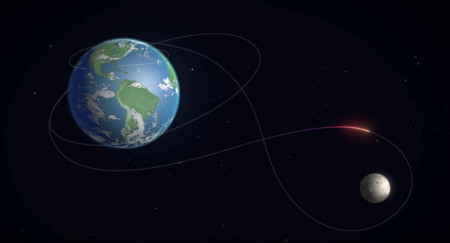
Artemis II has successfully launched, marking a significant milestone as humanity heads back to the Moon after more than 50 years. This isn’t just any mission; it signals a new era in space exploration. For the first time since the Apollo program, humans are embarking on a journey that will take them further from Earth than anyone has traveled in half a century.
Understanding Artemis II
The Artemis II mission represents NASA’s first crewed flight of its next-generation exploration system, primarily composed of the Orion spacecraft, the Space Launch System (SLS) rocket, and the ground systems at Kennedy Space Center. For approximately ten days, the crew will assess how the ship operates under real conditions, something that had only been tested without passengers until now. NASA emphasizes that this mission is a crucial step towards future lunar landings.
The Journey to the Moon
The countdown to this moment was fraught with tension. In the hours leading up to the launch, teams discovered an anomaly in a temperature sensor of the battery abort system, which was later attributed to instrumentation issues and deemed non-threatening to the mission. Additionally, an incident with the flight termination system, a backup mechanism for ensuring safety, briefly put the mission’s status at “no go.” Fortunately, both hurdles were resolved, allowing the long-awaited launch to proceed.
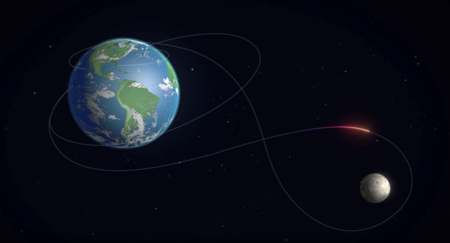
The planned flight path of Artemis II
In the following days, Artemis II will undertake a demanding yet relatively short mission. The spacecraft will initially enter a high orbit around Earth for 24 hours to verify all systems function correctly before commencing its voyage to the Moon. The crew will execute various maneuvers, including a manual control test and an approach to the SLS’s upper stage, to validate Orion’s performance. The mission includes a circumlunar flight and a return journey without landing on the Moon, designed to rehearse critical phases of the trip.
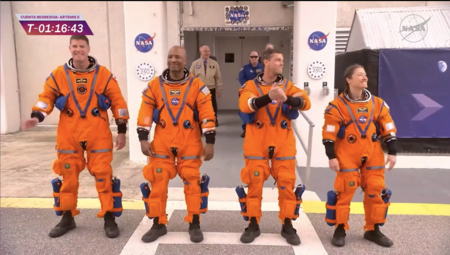
The crew of Artemis II
A Historic Crew
The Artemis II crew represents a blend of experience and symbolism. Mission Commander Reid Wiseman will be joined by Pilot Victor Glover and Mission Specialists Christina Koch and Jeremy Hansen. Together, they bring over 660 days of experience in orbit and 12 spacewalks to the mission. Moreover, Koch will make history as the first woman to travel to the Moon, while Hansen will be the first non-American lunar traveler, symbolizing a more inclusive future in space exploration.
Technical Contributions from Spain
A notable aspect of this mission involves Spain, specifically Tres Cantos, Madrid. The Thermal Control Unit of the European Service Module, designed, manufactured, and validated by Airbus Crisa, plays a crucial role in keeping the crew safe. It provides air and water and maintains temperature levels for both the astronauts and equipment. Although discreet, this essential system is crucial for ensuring a successful mission.
Images | POT
For comprehensive updates on the mission, keep an eye on NASA’s official page.