
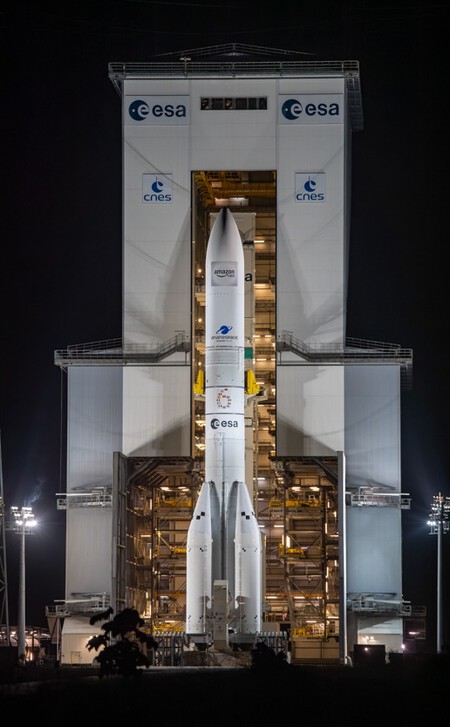
Ariane 64: A New Era for European Launch Capabilities
Putting large payloads into low orbit is not just a technical issue; it is also a strategic decision. When the payload figure approaches 20 tons, companies often look to the renowned Falcon 9 by SpaceX as the front-runner. However, Europe has recently demonstrated that it possesses a formidable option with the operational debut of Ariane 64, the most powerful variant of the Ariane 6, which successfully completed a mission deploying 32 satellites into orbit.
First Flight Success: Mission VA267
The VA267 mission marks a pivotal moment as Ariane 64 took off from the Guiana Space Center on February 12. According to ArianeGroup, the rocket not only successfully placed the payload into orbit but also completed the mission in just 1 hour and 54 minutes. This mission validates the rocket’s performance under real conditions and kicks off the first of 18 missions Amazon has contracted with Arianespace.
Advanced Capabilities: The Four-Thruster Configuration
Ariane 64 is tailored for the most demanding missions in terms of mass and cargo volume. With a capacity to transport around 20 tons to low Earth orbit, it can handle nearly double the payload of its sibling model, Ariane 62, which is limited to two lateral thrusters. This escalation in capacity underscores its potential for large-scale commercial deployments, such as entire satellite constellations. Furthermore, the program anticipates increased performance throughout the year with the addition of new engines, notably the P160C solid fuel thrusters.
Innovations and Milestones
VA267 was not just another launch; it featured multiple milestones that highlight the capabilities of the new European launcher. This mission marked the inaugural use of Ariane 64’s four-sided booster configuration and the deployment of more than 30 satellites into orbit. It also introduced a 20-meter fairing, designed to shield the dispenser during the rocket’s ascent, raising its total height to 62 meters—a significant increase from the previous Ariane 62 model, which stood at 56 meters.
Choreography in Orbit
The mission involved intricate choreography to ensure the safe release of satellites post-liftoff. The launcher detached from its side thrusters and fairing within minutes of liftoff. Subsequently, the upper stage took over for orbital insertion through meticulously timed ignitions. Satellite deployment commenced approximately 90 minutes after launch and unfolded through sequential releases.
Project Kuiper: Beyond the Launch
The satellite deployment is part of Amazon’s broader vision, dubbed Project Kuiper, aimed at establishing a low-orbit satellite system that provides fast, low-latency internet access to underserved communities. With the recent addition of these thirty satellites, the total count surpasses 200, moving Amazon closer to its goal of global connectivity.
A Turning Point for European Access to Space
With the successful inaugural flight of Ariane 64 and the satellite deployment carried out as planned, the new launcher transitions from technical validation to effective service. The real challenge lies ahead, emphasizing the importance of operational continuity alongside initial success.
Images | ArianeGroup