
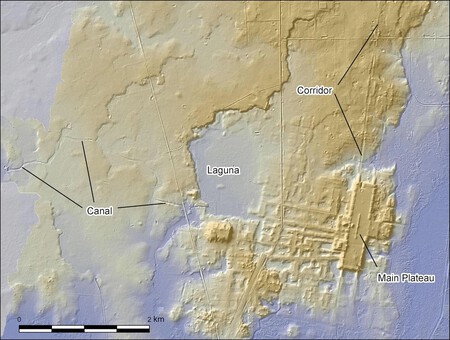
Aguada Fénix: A Cosmic Map of the Mayan World
Our understanding of the early Mesoamerican civilizations has deepened significantly thanks to recent archaeological discoveries. The site of Aguada Fénix, located in Tabasco, Mexico, has emerged as a groundbreaking monument that illustrates the intricate relationship between the Mayans and their cosmic beliefs.
What Is Aguada Fénix?
Discovered through the innovative application of LIDAR technology in 2017 by a team from the University of Arizona, Aguada Fénix is described as “the largest and oldest Mayan monument ever discovered.” The complex spans over 1,400 meters in length and features an extensive system of roads and waterways, suggesting its significance as a ceremonial center. Initial excavations revealed that it was constructed between 1000 and 800 BC, predating the well-known ceremonial site of Ceibal in Guatemala.
Historical Relevance
The discovery of Aguada Fénix shifts established narratives about the evolution of Mesoamerican societies. Instead of a gradual accumulation of large settlements, Aguada Fénix indicates an early instance of coordinated, large-scale construction. This monumental site challenges our understanding of social organization in Mesoamerica, pushing back the timeline of significant architectural ambition.
The Cosmic Connection
Aguada Fénix likely served not just as a gathering place but as a “cosmogram”—a representation of the universe according to its creators. Excavations uncovered ceremonial artifacts that echo the Mayans’ cosmic beliefs, including jade axes and decorations depicting a crocodile, a bird, and a woman in labor. Such items illustrate how the Mayans conceptualized their world order and the connection between time and space.
Unique Discoveries
Recent excavations have revealed striking details that further our understanding of this ancient site. Among other findings, researchers discovered mineral pigments arranged in specific patterns marking cardinal directions. This unprecedented arrangement of pigment is notable because it connects color symbolism with directional orientation, a concept integral to many Mesoamerican cultures.
Archaeological Insights
Evidence suggests that Aguada Fénix may have acted as a site for communal rituals. Rather than being built by forced labor under intolerant rulers, the construction appears to have been a collective effort undertaken by volunteers inspired by spiritual or cosmic convictions. This aspect illustrates a highly organized society that engaged its members in significant ideological projects without enforced hierarchy.
Conclusion
Aguada Fénix is more than just an impressive archaeological feat; it serves as a window into the Mayan worldview and social dynamics. As scholars continue to investigate this vast site, Aguada Fénix is poised to redefine our understanding of the early Mesoamericans, highlighting their astronomical knowledge and community involvement. The monument stands as a testament to a civilization whose influence has left an indelible mark on history, enriching our comprehension of the ancient world.