
The Cosmic Discovery of 3I/Atlas: Hubble’s Latest Achievement
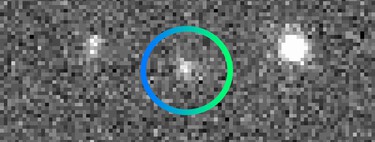
The veteran space telescope Hubble , with 35 years of service behind him, continues to demonstrate that he is in full form. His last feat has been to capture the first clear image of 3I/Atlas , an interstellar kite that not only comes from outside our solar system but seems to be older than the sun itself.
The Interstellar Object Number Three
3I/Atlas is the third celestial body beyond the solar system that astronomers have detected to visit our neighborhood, following the mysterious asteroid 1I/’Oumuamua in 2017 and the gigantic comet 2I/Borisov in 2019.
The images, taken on July 21 by NASA’s space telescope, offer a detailed first view of this new member of the interstellar club. The first alert was given by an astrophysicist student nicknamed Astrafoxen , who noted on their Bluesky profile: “There are many cosmic rays around, but the comet’s coma looks fantastic and bulky.” Indeed, even without processing, the images reveal a diffuse, active atmosphere surrounding the comet’s core.
An Unexpected Composition
Scientists have already begun to unveil the secrets of the comet. A preliminary study, based on previous images, has revealed that 3I/Atlas is an active interstellar kite containing abundant water . However, its cloud of dust resembles that of Type D asteroids : rocks filled with silicates, organic molecules , carbon, and water ice. The composition of the comet’s coma appears to be about 70% similar to the Tagish Lake meteorite, with the remaining 30% comprising water ice grains.
An Older Cosmic Fossil Than the Sun
Everything suggests that 3I/Atlas originates from a region of the Milky Way far older than our solar system. With an estimated age of 7 billion years , compared to the 4.6 billion years of the solar system, this kite serves as a time capsule from an era predating our own, which particularly excites astronomers.
Observation Missions and Future Exploration
First detected on July 1, 2025 , by the Atlas poll , the comet has quickly become the priority objective of observatories around the world. One of those joining the hunt is the Vera C. Rubin Observatory , equipped with the world’s largest digital camera, promising to uncover many more such interstellar invaders.
As the scientific community becomes more adept at identifying and studying interstellar objects, the implications for our understanding of the universe evolve. The analysis of 3I/Atlas could provide vital insights into the conditions and materials present in cosmic environments associated with the comet’s journey. It raises questions about the potential for life and the processes underlying planetary formation in older regions of our galaxy.
These interstellar visitors may serve as a glimpse into the past, revealing the history of our galaxy’s development and the diverse environments where celestial bodies are formed. As telescopes and technologies improve, the cosmic landscape will unfurl more secrets waiting to be discovered. Observatories around the globe are gearing up for a wealth of data that can enhance our comprehension of these intriguing objects in the universe.
The excitement surrounding 3I/Atlas reflects not only its unique composition and age but also the sheer wonder of exploration that continues to captivate scientists and the public alike. With continued observations and research, the cosmos will undoubtedly reveal even more astonishing discoveries.
In summary, the arrival of 3I/Atlas signifies a momentous occasion in astronomical exploration. Its unique characteristics provide a pathway into understanding the ancient processes that govern our universe. For astronomers, the opportunity to study such an ancient interstellar traveler amplifies the urge to seek more answers about the cosmos.
Images: Hubble (NASA), Gemini Observatory