
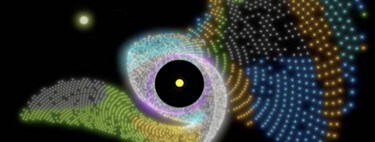
A New Discovery in the Solar System: Ammonite
In the dark confines of the solar system, beyond the orbit of Neptune, a new world has appeared. First detected in May 2023 from the top of the Mauna Kea volcano in Hawaii, astronomers have recently assigned it the name Ammonite . However, the discovery brings mixed news, particularly for those hoping to find the elusive Planet Nine .
Short Overview of Ammonite. 2023 KQ14, or “Ammonite,” is a trans-Neptunian object measuring between 220 and 380 km in diameter. It orbits the sun in an extremely wide elliptical path . A unique aspect of its orbit is its misalignment with other similar objects. According to a study published in Nature Astronomy, this finding challenges the hypothesis that a distant planet—speculated to be “Planet Nine”—could be influencing the trajectory of celestial bodies in this region.
A True Cosmic Fossil. The nickname “Ammonite,” akin to ancient marine fossils, is fitting. Astronomers believe this object is a relic of our solar system, a time capsule whose orbit has remained virtually unchanged for 4.5 billion years .
Its discovery was made possible thanks to the Fossil II Project (Formation of the Outer Solar System: An iory legacy), which tracked such objects using the Subaru telescope in Hawaii. The team found more than they anticipated; Ammonite is undeniably special .
An Exclusive Club of Celestial Bodies. In addition to its substantial size, Ammonite is located at an impressive distance. It has the third-most distant perihelion ever detected, with its closest point to the sun at 66 astronomical units —more than twice the distance of Neptune. Notably, astronomers identify this area as the ” perihelium gap ,” between 50 and 75 astronomical units, where such objects were previously unidentified .
Ammonite is classified as a sedoid , joining an ultra-exclusive group of trans-Neptunian objects. Prior to this discovery, only three such objects were known: Sedna (a candidate for a dwarf planet), 2012 VP113 , and Leleākūhonua . These celestial bodies are unique due to their enormous and highly elliptical orbits, with their closest points to the sun being so remote that the gravity of Neptune has minimal effect on them. They are, in essence, gravitationally isolated .
Implications for the Planet Nine Hypothesis. For years, the idea of Planet Nine has garnered attention to explain an unusual anomaly: the orbits of sedoids and other extreme trans-Neptunian objects appear to be clustered, as if a massive, unseen planet exerted gravitational influence over them.
However, Ammonite’s orbit does not align with this theory. In fact, it points in the opposite direction of those other three sedoids. Based on many proposed models for Planet Nine, Ammonite’s orbit would be unstable; it could not have remained in its current trajectory without being ejected from the solar system long ago.
So, What Happened? If Ammonite isn’t Planet Nine, what could have shaped these peculiar orbits? Researchers from the Synica Academy ran simulations on the orbits of the four known sedoids, discovering that, approximately 4.2 billion years ago , their perihelia might have been clustered together.
This raises intriguing questions about a cataclysmic event that happened around 300 million years after the solar system formed, affecting the trajectories of these objects. What force was strong enough to push them into such strange orbits?
Two leading candidates emerge. One is the near passage of a wandering star that may have approached the sun during its formative years, gravitationally disrupting the outer solar system. The second option is the existence of a giant planet that interacted with these objects but was expelled from the solar system—suggesting not the presence of Planet Nine, but the memory of a rebel planet that once roamed our solar system.
Image Source : Synica Academy
In conclusion, the discovery of Ammonite offers a fresh perspective on the dynamics of our solar system. While it poses challenges to the long-standing theory of Planet Nine, it also deepens our understanding of the complex gravitational interplay that shapes the trajectories of celestial objects. As scientists continue to study Ammonite and similar bodies, we may uncover more about the history of our solar system, revealing remnants of events that occurred billions of years ago.