
It is not the first time that we see a J-20s fly, but this time there is a key difference. According to Newsweek and The War Zone, several recent images posted on Chinese platforms show the biplaza model with five-digit license plates and the National Badge in Fuselage. Everything suggests that this unit has been assigned to the 172nd Air Brigade. For China, which has been preparing its technological leap in defense for decades, this could be a very important step.
Badges, Dark Paint, and Improved Sensors Appear
The images not only depict the J-20s with a darker body, reminiscent of black, but also reveal significant structural changes. Under the nose, a redesigned version of the monitoring electro-optic system is noticeable, featuring a more compact dome and 360-degree coverage, similar to the EOTS of the F-35.
The new paint scheme remains careful not to cover the edges of mobile surfaces, air intakes, and the tip of the radome. While Beijing has not disclosed specifics, indications point toward an improvement in the stealth properties of the plane, possibly including new radar-absorbent coatings.
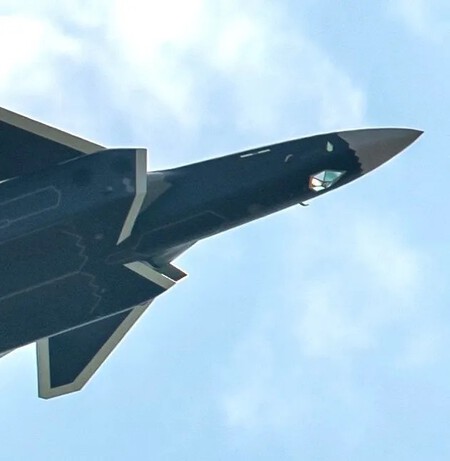
</div>The existence of the J-20 Biplaza was confirmed in 2021, when a prototype was caught performing high-speed shooting tests. From the outset, it has been compared to the F-22 Raptor due to its capabilities in air-to-air combat. However, the introduction of a two-seater version, like the one being showcased in recent images, presents a feature absent in any Western fifth-generation fighter currently in service. Neither the F-22, nor the F-35, nor the Russian Su-57 possess an operational two-seat variant.
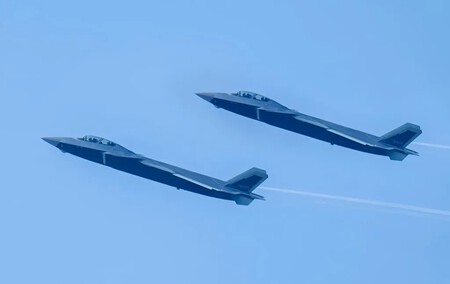
</div>This presents a notable distinction. While the United States and its allies have opted for systems with network interoperability, China appears to be extending its combat capabilities with this model by incorporating a second operator—to coordinate drone swarms or undertake advanced tactical tasks directly from the aircraft. This strategic divergence presently lacks an equivalent response from Western forces.
<img alt="China's military ambition has no limits. It has just resurrected one of the great Soviet fantasies: the EkranoPlano" width="375" height="142" src="https://i.blogs.es/838e5b/ps---plantilla-portadas-xtk-436/375_142.jpeg"/>Since the initial flight of the J-20s prototype, at least five more units have been documented, the most recent in March of this year, according to War Zone. It appears that China has been refining the design prior to increasing production. The paramount question now rests on how many of these biplaza versions will comprise the total fleet of J-20s—and what precise role they will play in actual operations. For now, their existence is confirmed.
As the global landscape of military aviation evolves, the introduction of two-seater stealth fighters could signify a paradigm shift in aerial combat tactics. With nations continuously seeking to enhance their defensive capabilities and improve on existing platforms, the competition in this sphere remains fierce. The development of the J-20 and its variants illustrates China’s commitment to advancing its military technology. As the West observes this progression, strategic adjustments may also be necessary to maintain a competitive edge, making China’s military aspirations and advancements crucial points of interest in global defense discussions.