
Hey, what was the title of Almodóvar’s last film?
Play the song that uses the basis of “Saturday Night” by Aitana.
Move the music to the living room.
Daniela is coming to dinner, do you think she will like this dish?
How do I look? Is this outfit formal for the event?
Buy my favorite wine.
Order a Cabify from here to Cibeles.
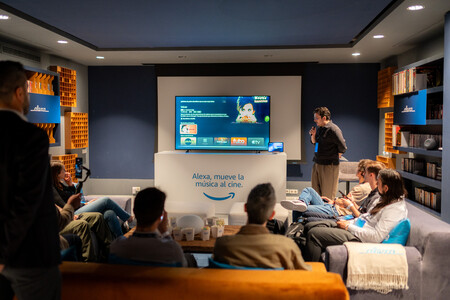
There is nothing strange in these sentences. They are how we speak. The rare thing, until now, was for an assistant to understand them well. Amazon brings Alexa+ to Spain with the promise to change that. After seeing it in a presentation just a few hours ago, the idea is clear: talk to our Echo devices so naturally that we forget that they are machines.
The Alexa+ Leap: Not Just AI, But Natural Communication
What Amazon is trying to sell with Alexa+ is quite simple to understand, at least on paper: stop talking to a speaker as if we are giving orders to a robot. The goal is to express ourselves naturally, to change subjects, leave half-sentences, or discuss matters as we would at home without overthinking our phrasing. During the presentation, Amazon summarized this ambition with a compelling phrase: “We no longer have to learn the Alexa language.”
Until now, our interactions with such assistants required us to adapt to the machine, repeating activation words and choosing terms carefully while avoiding detours. With Alexa+, the promise is essentially the opposite. We can ask it to change the music, inquire about a movie, continue a previous conversation, or link multiple thoughts without starting from scratch each time. This, according to Amazon, is where the real leap occurs.
A Functioning Assistant: The Shift from Responding to Acting
The other significant promise of Alexa+ is that it not only responds but also acts. This shift is manifested in features such as managing calendars, writing emails, and playing music according to personal tastes. The real transformation arrives when the assistant begins executing actions in real-world services like reserving tables or ordering cars.
In Spain, this functionality begins with partnerships involving TheFork, Cabify, and Tripadvisor. This means the assistant’s potential is not only based on its conversational skills but also on its ability to interact effectively with services beyond the home context. However, the initial offerings are still somewhat limited.
Personalized Context: A Promise of Enhanced Interaction
Amazon emphasized that Alexa+ improves when it has more context about the user. The knowledge can stem from daily activities, calendar entries, previous interactions, or explicit information shared by users. For instance, documentation like a school menu can be sent via email for the assistant to utilize later. In this way, Alexa+ can adapt its responses based on cumulative context.
This context-awareness is boosted further through the camera functionality on certain Echo devices. The presentation showcased how Alexa+ could “see” and answer questions about the current environment, recommending recipes based on available ingredients and even adjusting suggestions based on user preferences.
Real-Life Applications: A Test of Practicality
Our first impression after witnessing the presentation is that Amazon has crafted a compelling narrative around Alexa+ that clearly distinguishes it from the usual Alexa. The assistant appeared to handle requests naturally, understanding context and transitioning between tasks seamlessly. However, the real test will occur once it operates outside the controlled settings of a product demonstration and faces real-world scenarios.
Cost Structure and Accessibility
Another significant aspect of the launch is pricing. Initially, Alexa+ will be free during early access. Afterward, it will cost 22.99 euros per month if contracted independently, though it will be included in the Prime subscription in Spain.
To get started, Amazon offers two routes: purchasing a compatible Echo device for immediate access or registering for an invitation if you already own one. Amazon assures that invites will be rolled out in stages, with some functions not available on older Echo models.
Interestingly, this launch of Alexa+ does not coincide with new Echo speakers in Spain, as the service was launched earlier in the U.S. with new hardware. Nevertheless, models like the Echo Show 8, Echo Show 11, Echo Dot Max, and Echo Studio are equipped to support it.
The Future of Voice Assistance
The intriguing aspect of Alexa+ lies not only in the additional features or the new AI layer but in tackling the long-standing issue of users needing to adapt to the device. If Alexa+ manages to shift that narrative, it could represent a significant change in how we interact with technology. The company’s recent developments suggest positive advancements in that direction, yet the true measure of success will be whether this natural interaction holds up in everyday environments.
Images | Amazon | Xataka