
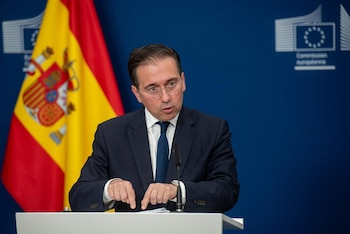
The ongoing humanitarian crisis in Gaza has prompted urgent calls for action from various international leaders. Recently, Spain’s Minister of Foreign Affairs , José Manuel Albares, addressed the high EU representative for foreign policy, Kaja Kallas, in a letter that underscores the pressing need for intervention. The letter emphasized the dire situation in Gaza, highlighting the unbearable humanitarian conditions the region faces due to ongoing blockades and military actions.
Urgent Appeal for EU Action
In his correspondence, Minister Albares urged Kallas to act “already” and “determined” to increase the pressure on the Israeli government. He called for an end to the blockade in Gaza and expressed his support for the two-state solution as a viable path to peace. The letter indicates that Spain has previously shown its support for initiatives led by Kallas, such as the agreement made in July between the EU and Israel regarding the entry of humanitarian aid into Gaza.
Despite these previous agreements, Albares noted that the blockade remains in effect. He warned that the continuation of these restrictions is leading to what he described as induced famine afflicting over two million people in Gaza. This situation, the minister argues, poses a significant challenge to the provisional measures issued by the International Court of Justice and contravenes resolutions set forth by the UN Security Council .
Israel’s Actions Hindering Peace
The minister’s letter did not shy away from criticizing Israel for its ongoing policies that contribute to escalating tensions in the region. Albares pointed out that Israel is undermining peace efforts through the expansion of new settlements in the West Bank and conducting military operations that weaken the Palestinian National Authority, a critical peace partner in the region. These actions, he argues, hinder the achievement of a lasting peace between Israelis and Palestinians.
Moreover, Albares indicated that he would propose new measures at the upcoming Informal Foreign Affairs Council —also known as Gymnich—scheduled to take place in Copenhagen, Denmark. His proposals aim to address the current humanitarian crisis more effectively and emphasize the EU’s role in promoting peace in the region. The situation in Gaza requires immediate attention, and ministerial proposals may lead to concrete actions that could alleviate suffering.
The Price of Inaction
As the humanitarian crisis deepens, the potential consequences of inaction loom large. Not only does the blockade lead to significant suffering for Gaza’s population, but it also has repercussions that extend beyond immediate humanitarian concerns. The impact on stability in the region, including the potential for increased unrest, could have far-reaching effects. Albares’ call for action serves as a reminder of the necessity for immediate diplomatic efforts and the implementation of effective policies aimed at resolving these complex issues.
The international community has a pivotal role to play in ensuring that humanitarian aid reaches those in desperate need and that dialogue continues to be fostered among stakeholders. The EU’s decisive involvement is paramount to navigating the challenges posed by historical grievances and current geopolitical dynamics in the region.
Conclusion
The remarks made by Spain’s Foreign Affairs Minister reflect an urgent call for action in a complex and evolving situation. The crisis in Gaza necessitates a multifaceted approach that balances humanitarian concerns with the pursuit of lasting peace. As leaders gather for discussions in Copenhagen, the world watches closely, hopeful for a unified stance that addresses both the humanitarian needs and the political realities of the region. Only through determined action can a path toward sustained peace and security be forged, benefiting both the individuals in Gaza and the broader Middle Eastern landscape.