
Spain is rich in culture , history , and diversity , featuring more than 8,100 municipalities spread across large cities and small villages. These settlements are nestled along the Cantabrian , Atlantic , and Mediterranean coasts, and vary in age from the ancient village of Brañosera, which dates back to the ninth century, to newer settlements whose origins may still be recounted by their residents. Among these recent establishments are the approximately 300 villages created during Francisco Franco’s regime, which were part of his controversial colonization policy.
The “Invented” Villages by Franco
55,000. This staggering number represents the families displaced by one of the most significant population movements in 20th-century Spain. Between the years of 1940 and 1970, the Franco administration established approximately 300 new settlements in 27 provinces, predominantly in Andalusia and Extremadura. This initiative prompted many families to leave their ancestral municipalities, enticed by the promise of new opportunities in these settlements.
“Villages of Colonization”. The monumental project was spearheaded by the National Institute of Colonization (INC), established in the aftermath of the Spanish Civil War to realize Franco’s agricultural vision. The program’s allure was undeniable; families that opted to relocate were promised homes alongside expansive irrigation lands. Unfortunately, the ideal painted by the INC did not always translate into reality .
Settlers were expected to meet specific criteria to qualify for land allocation. Although the lots were said to be distributed via a *lottery*, allegations arose suggesting that not all candidates had equal opportunity. Franco’s regime favored larger families that could contribute labor and adhered to its strict socio-cultural archetype— devout , hardworking Catholics. It was crucial that these settlers had no prior affiliations with the political opposition.
As reported by ABC, regulations established in 1945 outlined how settlers could access housing based on financial eligibility. Those capable of making a down payment could enter a phase dubbed “access to property,” while poorer settlers were subjected to a “tutoring” period that lasted up to five years , during which the INC retained some of their crops as payment.
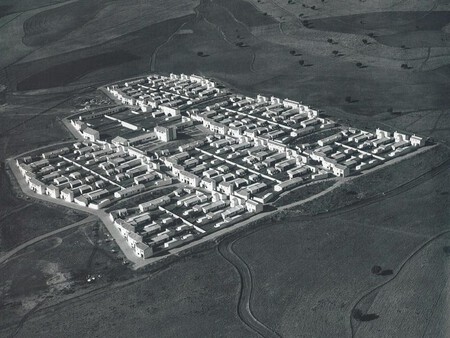
Villalba de Calatrava, a town of colonization of the Calatrava Campo (Ciudad Real) Campo.
Ultimately, how long settlers remained under these conditions depended on various factors. Reports indicate that some families experienced a protracted tutelage period slowing their transition to ownership. Furthermore, the repayment terms could extend up to 25 years , with high interest rates complicating matters.
To oversee the settlers, the INC established a detailed hierarchy that included agronomists and foremen , all the way down to local supervisors , to ensure adherence to the agricultural guidelines set in place.
Goals of the Colonization Projects
The Franco regime aimed to achieve multiple objectives through these new settlements. The program intended to facilitate agrarian transformation , broaden cultivable lands, and revitalize rural Spain. However, it had underlying ideological motives as well.
Many villages bore names that referenced Franco and his regime, encapsulating the dictatorship’s intent to propagate its image while facilitating infrastructure development across Spain. This was in line with the regime’s broader commitment to establishing new agricultural projects and irrigation initiatives.
The architectural landscape created by the INC featured modernist elements and is attributed to early-career architects like José L. Fernández del Amo and Fernando de Terán. These professionals contributed significantly to the architectural heritage we see in these towns today.
The colonization policies led to both positive and negative outcomes. While the infrastructural developments and some economic growth provided immediate benefits, the exploitation faced by many settlers, coupled with the unfavorable repayment conditions, created lasting hardships. Many settlers felt they were subjected to indentured service for years.
Decades after the creations of these villages, it has become clear that despite their problematic origins, many of the towns established during Franco’s regime have evolved into markers of modern artistry and architecture. These towns, once characterized by their affiliation to a dictatorship, now exhibit architectural gems often praised by modern scholars.
As we reflect on the complexities involved in Franco’s colonization projects, we can see that they have left an indelible mark on the cultural, social, and architectural landscapes of Spain, emphasizing the nation’s nuanced relationship with its past. Today, the narrative surrounding these settlements is one of recovery, reinterpretation, and, at times, reclamation.
Images | Castilla-La Mancha Board, Wikipedia