
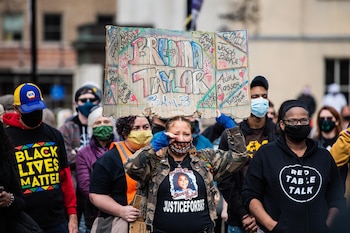
On Monday, former Louisville police officer Brett Hankison was sentenced to 33 months in prison following his conviction related to the tragic death of Breonna Taylor , an African-American woman. Taylor was shot and killed during a botched raid on her apartment in March 2020, an incident that ignited widespread protests and calls for justice across the United States and beyond.
The details of the case have continued to resonate with the public conscience, especially as the legal proceedings unfolded. Taylor’s family attorney, Lonita Baker , confirmed the sentence to NBC News , indicating that Hankison would also serve three years of supervised probation after his prison term. This legal outcome falls short of the Department of Justice’s recommendation for a lengthier and more stringent punishment, which would have included a consecutive federal sentence to address the gravity of Hankison’s actions. Taylor’s family subsequently expressed that the court’s decision felt like a “flagrant betrayal” of justice.
Hankison, previously a member of the Louisville Metro Police Department , was found guilty last year for violating Taylor’s civil rights through his actions during the raid. He fired at least ten rounds into her apartment, leading to a tragic series of events. Although he pulled the trigger multiple times, it was ultimately another officer’s bullet that fatally struck Taylor, exacerbating public outrage and calls for police reform.
The incident unfolded as part of a narcotics investigation targeting Taylor’s boyfriend, who resided separately at the time. When the officers executed a no-knock warrant to gain access to her home, Taylor’s boyfriend mistook the chaotic entry for an invasion. He fired a single shot at the officers, initiating a response wherein police discharged a staggering 22 rounds into the apartment. Sadly, one of these rounds hit Breonna Taylor, resulting in her untimely death.
The fallout from Taylor’s death was monumental, contributing to an amplified discourse surrounding racial inequality and police brutality in America. The country had already been grappling with high-profile cases involving Black individuals and law enforcement, including that of George Floyd , whose death also spurred extensive protests and activism. The loss of Taylor became emblematic of systemic issues within law enforcement and the urgent need for reform.
In the aftermath of her death, the Louisville Police Department faced intense scrutiny and widespread public backlash. Activists and community leaders argued that the policies and practices leading to such events must be critically examined and overhauled. A call for accountability resonated throughout neighborhoods and on social media, leading to a larger movement advocating for racial justice and police transparency.
Despite the conviction of Hankison, many in the community continue to feel that true justice remains unattainable. The sentencing does not reflect the profound loss endured by Taylor’s family and friends, nor does it entirely address the systemic issues at play. Thus, discussions surrounding police practices, the use of force, and the importance of genuine accountability remain pressing and unresolved.
As the effects of Breonna Taylor’s death ripple through the fabric of American society, her legacy continues to inspire activism and discussions about equity , justice , and the urgent need for systemic change in law enforcement. The battle for meaningful reform is ongoing, as many advocates vow to honor her memory through their relentless pursuit of justice and equity for all victims of violence and oppression.