
Modernizing Public Administration: A New Opposition Model in Spain
The Spanish government is facing a significant challenge imposed by the European Union : to modernize and elevate its public administration to meet European standards of excellence. In response, the Ministry for Digital Transformation and Public Function has recently unveiled a new proposal for reforming the opposition model for top state officials.
This reform will specifically impact future officials in the A1 and A2 subgroups, which include roles requiring high specialization, such as judges, finance inspectors, and senior architects. Until now, these officials were required to hold a specific university degree, but under the new framework, they will also need to complete a two-year postgraduate course to qualify for public positions.
An opposition with two exams. Minister Óscar López has emphasized that this transformation is rooted in “maximum rigor and European standards,” with the intention to “enhance the selection process and the talent entering the administration.” As outlined in the ministry’s proposal, the objective is to attract “the best candidates” through an intensive training program equivalent to those found in countries like France or Germany.
<img alt="The public sector as a refuge for employees undervalued by private companies: 45% of opponents already have a job" width="375" height="142" src="https://i.blogs.es/36e4c3/russia-office-men-women-51a0b99ab06a944ee504e0158f574b17/375_142.jpeg"/>Under this new system, candidates will first undergo an aptitude test , designed as a preliminary filter. Successful candidates will then have the opportunity to attend a National Training School for Officials , where a comprehensive two-year postgraduate training program will be offered.
This postgraduate program will be mandatory before candidates can sit for the final exam , leading to public positions specific to their areas of training, thus streamlining the currently existing opposition method.
Not everyone will pass. While many candidates may pass the first exam, it’s important to note that not all will secure a position, as many who pass the first exam may not succeed in the second. However, candidates who complete the two-year postgraduate program without obtaining a position will still receive an official postgraduate degree.
According to Secretary of State for Public Function, Clara Mapelli , this officially recognized title, akin to a university master’s degree, will provide value for the two years spent training at the School of Officials.
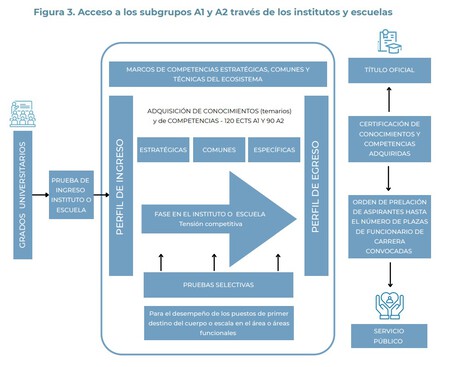
<span>New training scheme for high-ranking officials</span>Academic credits according to the group. The Ministry’s proposal also introduces a training system based on ECTS credits (European Transfer and Accumulation of Credits). For instance, candidates in the A1 subgroup will need to acquire 120 ECTS , while those in the A2 group will require 90 credits , with 60 ECTS needed for group B .
Candidates for groups C1 and C2 will follow distinct guidelines. They will require 30 and 10 credits , respectively, but for group C2 , the training will commence only after they have been assigned a position, ensuring that their training is directly applicable to their roles.
<img alt="A study has compared the public salary gap vs. private in Europe and has found a problem: Spain" width="375" height="142" src="https://i.blogs.es/c90e17/rut-miit-rbc4-8cdbvq-unsplash/375_142.jpeg"/>The French model. The academic structure proposed by the Ministry draws significant inspiration from the French model of the École Nationale d’Enchion (ENA) , established in 1945 and notable for having educated four of France’s recent presidents, including current President Emmanuel Macron , who has since reformed it.
To actualize this new National School, the Ministry has initiated alliances with both European Administrative Schools and universities within the European Higher Education Area . Moreover, the system will integrate with the state scholarship regime to ensure equal opportunities, irrespective of an applicant’s socioeconomic background.
Reactions against. However, not everyone is supportive of the new opposition model. Trade unions and professional associations have raised concerns. The State Finance Inspectors Association (IHE) cautions that the new model, which reveals candidate identities for the second exam, poses a significant risk to the integrity of public service.
Additionally, Miguel Borra , president of the CSIF union , commented to Public that the new model “won’t resolve the serious issues facing administrations and their professionals.” He warned that 60% of public employees are due to retire in the next decade while 30% of positions are temporary, suggesting that the new model might exacerbate existing challenges.
Union representatives also forewarn that this revamped system could lead to further delays in selection processes that already contribute to the expiration of many positions each year due to administrative inactivity.
In conclusion, while the Spanish government’s proposal for a new opposition model aims to modernize public administration and align it with European standards, it faces skepticism from various sectors. Concerns about potential pitfalls and administrative burdens remain prevalent, indicating that substantial dialogue and adjustments may be necessary for successful implementation.
Image credits: Pexels (Tima Miroshnicenko)