
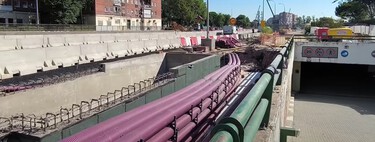
Burying the A5: A Major Infrastructure Project in Madrid
On January 15, 2025, Madrid embarked on a significant infrastructure project that has been years in the making: the burying of the A5 . This urban highway is critical to the city’s transportation network, accommodating around 80,000 vehicles daily . Since its completion in 1968, it has physically divided communities, severing connections between neighborhoods like Aluche, Las Águilas, Lucero, Batán, and Casa de Campo. The project aims to eliminate this barrier by re-establishing the neighborhoods and enhancing the urban landscape.
The construction method chosen for this ambitious project is the ‘cut and cover’ technique , a time-tested method widely used for creating surface tunnels. While more advanced technologies like tunnel boring machines (TBMs) exist for deeper excavations, the cut and cover method provides a practical alternative when working at shallower depths.
Understanding the ‘Cut and Cover’ Technique
The ‘cut and cover’ technique involves the following process: first, a trench is excavated from the ground surface. A new road structure is then constructed within this trench, and finally, the trench is backfilled with fill material. There are two adaptations of this approach:
- From bottom to top: The trench is dug with support, and the tunnel is constructed inside. Once completed, the trench is backfilled, and the surface is restored.
- From top to bottom: In this variant, lateral retaining walls and tons are first erected at ground level. The roof is excavated afterward, and prefabricated beams are installed allowing the surface to be reinstated quickly.
In this video, a piloting machine works vigorously, essentially functioning as a giant “drill.”
Each variant of the cut and cover technique has its unique advantages and challenges. Generally, these methods are more economical and practical for projects requiring tunnels at depths around ten meters when compared to deeper tunneling methods.
The Impact on Traffic and The Community
The objective of using the cut and cover method is to minimize disturbances to daily traffic, especially in critical areas like the A5. However, the reality has been somewhat chaotic. The current construction has transformed one of Madrid’s major entry points into a bewildering maze of detours and tight curves, making the route resemble scenes from a video game like Mario Kart . This situation has led to substantial frustration among commuters, prompting the Madrid City Council to receive numerous complaints and even consider modifying certain curves.
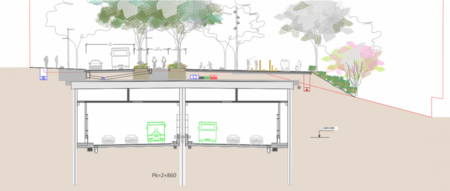
The project involves 3.2 kilometers of the highway being buried through the construction of concrete containment screens and the installation of covering slabs above. Approximately 600 workers are laboring on-site, utilizing around a hundred specialized machines, including the notable piloting machines designed for creating piles—these are underground columns constructed by injecting concrete into metal reinforcements or using prefabricated units.
The construction of the “new” A5 will necessitate the installation of more than 6,000 piles made of reinforced concrete. Additionally, the Parque Castellana project is also adopting the cut and cover technique, which will include a 675-meter tunnel with 2,041 piles.
While the cut and cover technique has been around since the Paris Metro’s construction in 1900, it remains one of the least disruptive options for creating urban tunnels. However, the inconveniences faced by local residents and commuters during this project could provoke differing opinions on its effectiveness.
Images | Xofc, Madrid Diary
In Xataka | 20 years later, Europe faces one of the greatest engineering milestones in its history: the longest railway tunnel in the world