
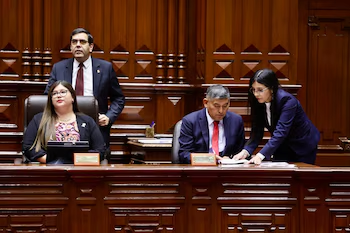
Cecilia Chacón’s Warning Over Vote Disclosure Ignored in Chamber of Deputies Election
During the recent election for the Board of Directors of the Chamber of Deputies for the period 2026-2027, President of the Preparatory Board, Cecilia Chacón from the Fuerza Popular party, issued a stern warning against revealing votes. Despite her caution, many legislators opted to disregard it, leading to an unusual display of noncompliance within the parliamentary chamber.
The Importance of Secret Voting
Before the voting began, Chacón emphasized the significance of maintaining the secrecy of votes, citing Article 87, paragraph (c) of the Chamber’s Regulations. This article clearly states that voting by ballot is confidential and any violation of this principle could result in a constitutional accusation. Despite this, a number of deputies showcased their ID cards on camera post-vote, a move that was met with applause from their peers. This blatant disregard for Chacón’s warning raised eyebrows and questions regarding the enforcement of rules within the assembly.
The Election Process
The election featured two main lists competing for leadership. The first list included prominent candidates like Óscar Reto Otero from the Good Government Party for president, alongside Analí Márquez from Together for Peru as first vice president. Other notable representatives included Harvey Colchado and José Yataco holding the second and third vice-presidential roles, respectively.
Conversely, the opposing list presented Norma Yarrow from Popular Renewal, with Karina Beteta from Popular Force as first vice president. The competition was intense, and despite Chacón’s warnings, many members seemed unperturbed, indicative of a deeper cultural issue rooted in parliamentary behavior.
Reactions and Political Dynamics
Hours prior to this voting event, the chamber also saw the election of Michael Torres as president of the Senate, an occasion shrouded in controversy due to accusations of “treason” leveled against fellow congresswoman Silvana Robles from Together for Peru, who abstained from voting, defying an already established opposition coalition agreement.
Ernesto Zunini, spokesperson for the opposition faction, voiced concerns over the restrictions placed on media and advisors during the session. Such measures sparked outrage and raised questions about transparency within the new bicameral parliamentary structure, which had only recently returned after more than 34 years of being unicameral.
The Call for Transparency
Reflecting on the events, Zunini contended that enabling media access was essential for promoting accountability among elected officials. He expressed dissatisfaction over seemingly preferential treatment towards certain deputies and senators, emphasizing that representatives should operate within an environment conducive to public scrutiny.
Conclusion: A Bicameral Parliament’s Challenge to Ensure Order and Secrecy
Peru’s political landscape continues to evolve with the establishment of a bicameral parliament designed to overcome the instability associated with its previous unicameral structure. This recent voting incident underscores persistent challenges in enforcing procedural norms and fostering a culture of respect for legislative laws. As representatives embark on their duties for the new term from 2026 to 2031, ensuring compliance with foundational democratic principles will be crucial in restoring public trust in the political process.