
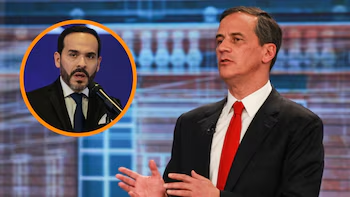
Political Tensions Within the Democratic Center: A Rift Over Rafael Nieto Loaiza’s Comments
The statements made by Senator Rafael Nieto Loaiza of the Democratic Center regarding the newly elected president, Abelardo de la Espriella, have stirred notable controversy within political circles. On July 26, Congress members from the Democratic Center swiftly distanced themselves from Nieto’s assertion of an ongoing “war” with the president, highlighting tensions and differing strategies within the party.
Diverging Views on Leadership
Senator Juan Espinal, among the first to publicly respond, emphasized the need for unity within the party. “I respect Rafael’s position, but I do not share it,” he said, reaffirming his commitment to support President De la Espriella’s agenda. Espinal pointed out that the real effort should focus on national priorities such as security, health, and public finances, rather than engaging in factional disputes.
Similarly, other party members echoed Espinal’s thoughts. Senator Hernán Cadavid stated, “The only ‘war’ of the Democratic Center is against insecurity and poverty in Colombia,” further reinforcing the party’s intent to operate as a governing coalition rather than an opposition force.
Shifting Political Strategies
The emerging rift within the Democratic Center exposes underlying strategic differences. While Nieto called for a confrontation with the incoming administration, colleagues like Senator Andrés Forero stressed the importance of addressing national challenges. Forero declared, “The war is against terrorism, not against a president with whom we have clear programmatic convergences.”
This pushback from prominent figures demonstrates a collective inclination to seek collaboration over conflict, as party members aim to prevent internal strife that could empower their political rivals.
A Call for Institutional Commitment
Representative Santiago Castro articulated a desire for collaboration, acknowledging Nieto’s experience while reiterating his commitment to work alongside President de la Espriella’s government. Castro stated, “I have the desire to work on all projects that benefit Colombia,” thus signaling a shift toward institutional dedication rather than divisive rhetoric.
Similarly, Representative Daniel Briceño summarized the stance of many party members, stating, “The war is against crime, not against Abelardo.” His remarks suggested a focus on uniting efforts to tackle broader social issues rather than engaging in potentially damaging personal or institutional disputes.
The Broader Implications
The controversy surrounding Nieto’s remarks reflects a significant moment for the Democratic Center as it navigates its role in the current political landscape. While some seek a more confrontational stance, the majority appear committed to fostering cooperative governance, recognizing the necessity of unity in the face of organized opposition.
Nieto’s statements have opened discussions about the future direction of the party, especially amid shifting leadership dynamics in Colombia. As the Democratic Center balances its internal perspectives, its approach to the de la Espriella government could define its positioning for years to come.
Conclusion
In essence, the Democratic Center is at a crossroads, grappling with the implications of Rafael Nieto Loaiza’s controversial statements. As party members emphasize collaboration and focus on pressing national issues, the path ahead will hinge on their ability to unify under a common cause while establishing their identity within a changing political environment. The unfolding narrative reflects the delicate balance of power, collaboration, and ideological fidelity in Colombian politics today.