
The Evolution of Line 10: A Key Player in Madrid’s Transport Network
Line 10 of the Madrid Metro is a vital artery in the city’s transport system, boasting almost 84 million users according to 2024 data. It serves as the fastest link between the southern regions and the financial hubs in the north of Madrid, surpassing only Lines 1 and 6 in ridership.
Historical Context
Though Line 10 appears to be one of the more modern lines, its roots trace back to the 1960s when a private company known as Carabanchel Suburban Railway managed its operations. The combined route of what we know today as Line 5 and 10 began its journey there.
In the 1980s, the Madrid Metro absorbed the private company, leading to the re-numbering of parts of the route, including what eventually became Line 10, linking Plaza de España and Alonso Martínez.
Transport Revolution in the South
The following two decades saw significant transformations in Madrid’s south. The connection with Line 6 at Príncipe Pío revitalized the old North Station, establishing it as a transport hub.
By the 1990s, the link from Casa de Campo to Aluche began integrating with Line 5, ultimately making Colonia Jardín the head of Line 10. The early 2000s welcomed the opening of Line 12, creating a circular route connecting multiple southern towns to Line 10.
A Major Engineering Challenge
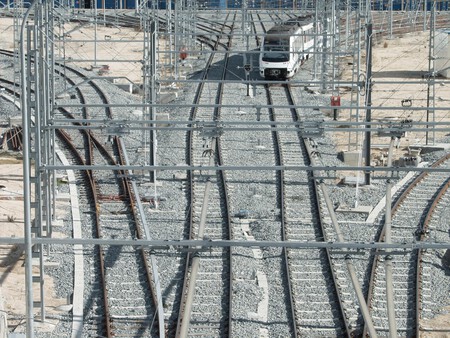
With line 10 set to become one of the city’s primary mobility channels, Madrid Metro faced an enormous challenge: constructing new tunnels and auxiliary facilities. Critical among these was the Cuatro Vientos garage, a project launched in 2002 aimed at managing train flow.
Site Constraints and Solutions
Building the depots posed challenges due to their location. Situated between the M-40 ring road, the A-5 highway, and Cuatro Vientos highway, there was limited space for construction.
Unlike traditional mining techniques, where tunnels are dug underground, the project embraced a “cut and cover” approach, digging a false tunnel and then covering it to recreate surface conditions. This method was essential given the proximity of both train tracks and heavy traffic.
A Massive Earth Removal Effort
Ultimately, the project required the removal of an astounding 300,000 cubic meters of earth. This operation allowed for the construction of the necessary space to accommodate up to 30 trains, covering a total area of 395,441 square meters and featuring over five kilometers of tracks.
In addition to the garage facilities, the site also includes an auxiliary building equipped with simulation rooms for the training of future train operators.
Conclusion
The strategic enhancements made to Line 10 underscore the commitment to evolving Madrid’s metro system to better serve its citizens. This endeavor did not just solve an operational challenge but also significantly boosted the city’s transport reliability.
Photos | Madrid Metro
In Xataka | 400 cameras and an ambitious goal: the first metro driven 100% autonomously in the Community of Madrid