
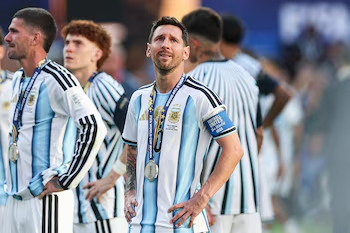
The Alleged Anti-Argentine Campaign on Social Networks: An Analysis
Background and Context
The recent performance of the Argentine National Team in the World Cup has sparked international debate that goes beyond sports. Following their notable success, various sectors on social media and in foreign media outlets began promoting criticisms of the team, leading to a perception of an alleged anti-Argentine campaign. Accusations labeling the team as “dirty,” “cheating,” and “dishonorable” proliferated, creating polarized discussions and making it increasingly challenging to separate genuine criticism from biased narratives.
The Role of Social Media
Social media platforms significantly amplified these accusations. Algorithms from platforms like TikTok, X (formerly Twitter), YouTube, and Instagram favored rapid dissemination of negative content. Users found it easy to access automatic translations, allowing misinformation to spread widely. This environment facilitated the viralization of alleged harangues or incidents of violence related to the team, contributing to a toxic online atmosphere.
Voices of Expertise
Lucas Malaspina, a Digital Public Affairs consultant, explained that social media dynamics encourage the spread of misleading information. He noted, “The incentive system of social networks makes content creators produce material that yields more if it generates anger or controversy.” While Malaspina avoided claiming a centralized organization behind the anti-Argentine sentiment, he acknowledged the existence of disinformation campaigns designed to influence public opinion.
Political Influences
The global political context seemingly played a role in shaping perceptions of the Argentine team. The presidency of Javier Milei, who has taken a strong stance in support of Israel, added another layer of complexity. As Malaspina pointed out, part of European and Latin American progressivism leverages Argentina as a symbol in their political disputes. Thus, the Argentine team became embroiled in a wider international discourse, increasing its visibility and scrutiny.
Cultural Misinterpretations
The narratives surrounding perceived “creole liveliness” and the conduct of certain players were misinterpreted. International media, including leading publications like The New York Times and The New Yorker, framed the Argentine team as “petulant” or “dishonorable,” failing to appreciate the intricacies of Argentine identity and the cultural significance of soccer. Malaspina emphasized that the contrast between internal evaluations of the team and external perceptions were central to the ongoing debate.
A Polarized Global Image
Argentina’s portrayal has led to a polarized image, not universally negative but marked by strong reactions. Malaspina remarked that social media tends to highlight voices critical of Argentina, making those narratives more viral. In contrast, positive sentiments from regions like Asia and certain parts of Latin America received less visibility.
Conclusion
The alleged anti-Argentina campaign illustrates the complex nature of global communication in the digital era. Social networks have heightened Argentina’s exposure, resulting in amplified criticism and support alike. The fluidity of information, often without rigorous verification, complicates public perception. This situation underscores the importance of understanding the intertwining roles of politics, media, and culture in shaping the narrative around sporting events.
The discussion about this phenomenon reveals a deeper insight into how sporting victories can influence and be influenced by global dynamics and sentiments, challenging traditional notions of nationalism and identity in the age of digital communication.