
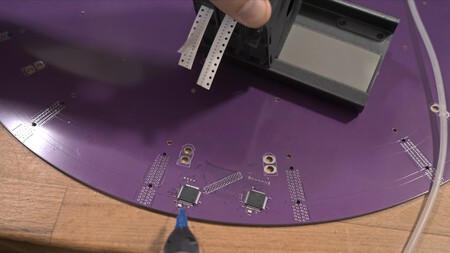
For years, building a GPU was thought to be the exclusive domain of large tech companies equipped with sprawling manufacturing facilities and multi-million dollar budgets. The complexity of modern graphics cards certainly supports this belief. However, Matthias Balwierz, known as Bitluni, is challenging this perception. His latest endeavor involves constructing a graphics machine at home using thousands of RISC-V microcontrollers, not to replicate commercial giants like NVIDIA, but to explore innovative possibilities in hardware design.
The First Phase: Microcontroller Marvel
Bitluni’s project begins with a staggering 8,192 microcontrollers, each directly connected to an RGB LED. This unique configuration merges graphic processing with the display surface into one cohesive unit, challenging traditional categories within hardware design. The architecture is envisioned to function as both a graphics card and an integrated screen, operating independently of a separate monitor. Presently, this remains a partial prototype, with further development needed to attain the envisioned scale and capabilities.
A GPU Made Pixel by Pixel
The design phase was not straightforward. Bitluni initially considered creating a unique screen but ultimately decided against high-cost, addressable RGB components. Instead, he soldered an LED to each microcontroller, transforming each microcontroller into its own independent graphics unit. Although this choice kept costs down, it significantly increased the complexity of the design, assembly, and programming required to synchronize thousands of components.
This ambitious project had to strike a balance between ambition and practicality. While a standard Full HD resolution (1920×1080) would necessitate over two million microcontrollers, Bitluni adjusted his goal to a vintage resolution of 320×200—still requiring a hefty 64,000 chips for the final product. The initial components are just a starting point, with plans to almost quadruple the size when completed.
Structuring the Hardware
To manage the considerable number of microcontrollers, Bitluni organized the system into modules constructed from 16×32 “pixel” boards. Arranged in a circular layout reminiscent of the historic Cray-1 supercomputer, this design allows for each group of 32 microcontrollers to operate under the control of a more powerful CH32V unit. This hierarchical approach aids in sustaining efficient communication and coordination across the entire machine.
Efficient Yet Costly Design Choices
The selection of the QingKe CH570 microcontroller underpins the project’s budgetary strategy. Each unit features a 32-bit RISC-V CPU with a frequency of up to 100 MHz, alongside integrated peripherals like a USB controller and Bluetooth capabilities. At just $0.13 per unit, the cost remains attractively low; however, the total cost for 320×200 pixel support will exceed $8,000—reinforcing the importance of prudent planning.
Power and Infrastructure Challenges
One of the challenges lies in the power requirements. The anticipated configuration needs approximately 2,161 W, translating to around 655 amps at 3.3V. Each microcontroller consumes about 10 mA, but the complete power budget must account for chips, LEDs, and supporting electronics. To meet these demands, Bitluni sourced a Corsair WS3000 power supply and developed converters to adjust the output from 12V to the necessary 3.3V.
Innovative Solutions and Programming
Crafting the necessary infrastructure demanded a lot of creativity. Bitluni designed printing circuit boards (PCBs), power circuits, and other essential components while experimenting with multilayer boards. He even considered immersion cooling solutions to manage heat while being cautious about cost and environmental impacts.
Programming the microcontrollers posed another challenge. Rather than manually loading the firmware into each unit, Bitluni repurposed his 3D printer by designing a tool that could automate the process. A Python script controlled the printer, moving it precisely to each chip’s location, thereby effectively transforming it into a programming machine.
Conclusion: A Unique Engineering Experiment
This project may not rival modern GPUs in performance or efficiency, nor has it achieved its full potential yet, but its real value lies in the exploration of component-level tasks. By disassembling functionalities typical of commercial GPUs and reconstructing them using accessible hardware, Bitluni opens new avenues for design, testing, and incremental development. This unique undertaking combines ingenuity with engineering, pushing the boundaries of home technology and creativity.
Images | Bitluni