
China’s Tianwen-2 Reaches Kamo’oalewa: A Decade-Long Mystery Unfolds
After 400 days of travel, China’s lunar exploration probe Tianwen-2 has arrived at its target: the enigmatic object known as 469219 Kamo’oalewa (2016HO3). This mission has generated significant excitement within the global astronomical community, which has been grappling with the mystery of Kamo’oalewa for more than a decade. Although the Chinese National Space Administration (CNSA) only announced the arrival on July 6, the spacecraft actually reached its destination on July 4.
A Groundbreaking Journey
The Tianwen-2 mission was launched on May 29, 2025, and made a journey of approximately 20 kilometers from Kamo’oalewa. Images captured by Tianwen-2 will assist in mapping the surface of this celestial body, helping scientists determine precise locations for future sampling efforts. These samples, when returned to Earth in 2027, aim to answer a pivotal question: is Kamo’oalewa an asteroid or a fragment ejected from the Moon?
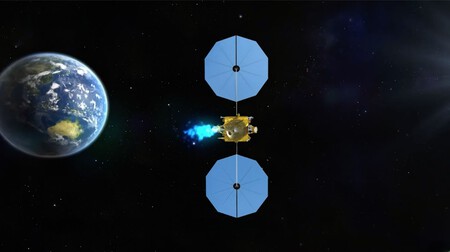
Tianwen-2 has been traveling for 400 days
Advanced Instruments on Board
Tianwen-2 carries 11 sophisticated instruments designed for in-depth study of both Kamo’oalewa and its subsequent target, the comet 311P/PANSTARRS. These instruments include cameras, laser measuring devices, spectrometers, sonar radars, and particle analyzers, complete with a specialized dust analyzer developed in Italy, known as DIANA.
The Mission’s Two Key Phases
1. Mapping the Surface: The probe is currently capturing images from various angles to create a detailed 3D model of Kamo’oalewa. This model will help scientists select locations that are both scientifically interesting and safe for sampling—avoiding unstable ground or loose rocks.
2. Collecting Samples: Due to uncertainties regarding Kamo’oalewa’s surface composition, Tianwen-2 uses three methods for sample collection: suspension, touch and match, and anchor and coupling. The suspension method involves hovering above the surface to extract samples using a robotic arm. The touch and match method employs a gas-powered disc to make brief, forceful contact with the surface, while the anchor and coupling method utilizes robotic arms to gather material for an extended period.
Unraveling the Asteroid Mystery
The classification of Kamo’oalewa remains elusive. Initially, estimates suggested it had a diameter between 40 and 100 meters, with hypotheses pointing to it being either an asteroid or a fragment from the Moon. Notably, a recent measurement from Tianwen-2 indicates that Kamo’oalewa measures approximately 20 meters in diameter, a significant reduction from earlier estimates but consistent with findings from the James Webb Space Telescope.
Understanding Quasi-Satellites
Kamo’oalewa is categorized as a quasi-satellite of Earth due to its similar orbital period around the Sun. This creates an optical illusion that makes it appear to orbit our planet, which further complicates its classification.
Awaiting the Final Verdict
Initial data from Tianwen-2 suggests that Kamo’oalewa may not be a fragment from the Moon, likely leaning toward the asteroid hypothesis. However, until samples reach Earth in 2027, the mystery will remain unsolved.
Image Credits: CNSA