
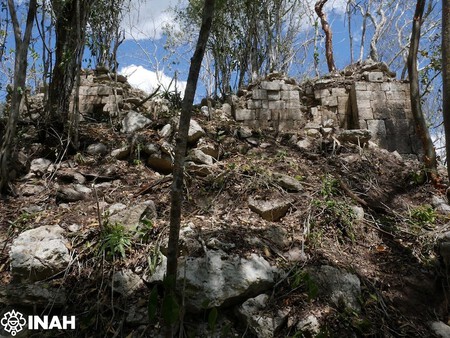
## Discovering Minanbé: A Hidden Mayan City
Archaeologists recently uncovered a pre-Columbian site named Minanbé, which translates to “there is no way” in Yucatecan Mayan. This hidden city, located in the dense jungle of Campeche, Mexico, was uncovered by a research team led by Slovenian archaeologist Ivan Sprajc. It is believed to have played a significant role during the Late Classic period, roughly between 600 and 900 AD.
## The Journey to Minanbé
After years of research and countless kilometers traversed under the unforgiving sun, the team finally reached this forgotten settlement, which had remained untouched by human activity for over a millennium. This incredible discovery is precisely why the National Institute of Anthropology and History (INAH) has sparked excitement in the field of pre-Columbian archaeology.
The remoteness of Minanbé contributed significantly to its preservation. The archaeologists faced immense challenges traveling through thick jungle with only quads and machetes to clear their path. They had to carve out a route, struggling through mud and undergrowth for up to five kilometers to finally arrive at the site.
## How Was Minanbé Discovered?
The use of advanced technology played a crucial role in locating Minanbé. LiDAR technology allowed researchers to perform aerial scans, revealing structures hidden beneath the vegetation. These scans were conducted over a decade ago, marking the beginning of the journey to uncover this archaeological treasure.
During this most recent field season, the research team sought to confirm LiDAR findings on the ground. They found evidence of an urban nucleus encompassing palatial buildings, religious sites, and even hydraulic structures.
## The Significance of Minanbé
The challenging accessibility of Minanbé has its advantages. Ivan Šprajc noted the absence of looting—a stark contrast to many other regions. This lack of disturbance is a significant factor for archaeologists, signifying that Minanbé may hold well-preserved artifacts and features.
When the team arrived, they discovered an urban core featuring notable architectural elements. Among these is a towering, pyramid-shaped temple reaching over 13 meters, showcasing a style reminiscent of the Río Bec architecture. The findings at the site highlight not just its grandeur but its potential as a political center in ancient times.
## Cultural Insights and Future Research
Experts like Vitan Vujanović have documented various structures, including altars and stelae, many of which still display fascinating glyphs—some relating to dramatic events such as a decapitation scene. Researchers are now developing 3D models to dissect these engravings further, revealing insights into the cultural significance of Minanbé during the Terminal Classic period.
The exploration continues, with investigators seeking to understand more about Minanbé’s role and its connection to larger socio-political networks of the Mayan civilization.
## Conclusion
The discovery of Minanbé opens a remarkable chapter in the study of Mayan history. As researchers continue to delve into this hidden gem, we can expect to gain deeper insights into the lives and culture of the ancient Maya. This incredible find not only adds to the existing body of knowledge but also underscores the importance of preserving such sites for future generations.