
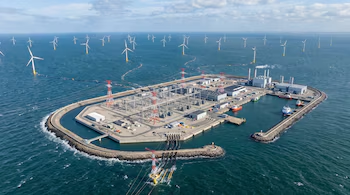
Denmark’s Ambitious Energy Island in the North Sea
Denmark is planning to build an artificial island in the North Sea, approximately 80 kilometers from the Jutland peninsula. This innovative project aims to centralize and distribute electricity generated by hundreds of offshore wind turbines. According to the Danish Energy Agency, the energy island will initially have a capacity of 3 GW, expandable to 10 GW by 2040, potentially supplying energy to around 10 million European homes. The project seeks operational readiness by 2036, pushing past initial targets set for 2033.
Project Details
The energy platform will cover at least 120,000 square meters and will be interconnected through high-voltage submarine cables with Denmark, Germany, the Netherlands, Norway, Belgium, and the United Kingdom. This installation will operate as a marine power station, collecting energy generated by various nearby wind farms and transporting it to land via an expansive interconnection network.
Financial Considerations
Financial challenges play a significant role in the project’s progression. The estimated total cost exceeds DKK 210 billion (equivalent to 28-30 billion euros), with around 10 billion euros earmarked for constructing the island and its docks. The budget also includes expenses for wind farms and electrical interconnections. An additional 50 billion Danish crowns (approximately 6.7 billion euros) has been projected as extra costs.
International Energy Distribution
The envisioned electrical network aims to distribute energy generated by offshore wind farms across several Northern European countries. The plan includes exporting energy through high-voltage submarine cables to connected nations, while a portion of the electricity produced will contribute to green hydrogen production via electrolysis, intended for use in maritime transport and aviation.
Environmental Implications
While the potential benefits are substantial, environmental impacts must also be addressed. Construction of the artificial island and submarine cables could affect the seabed and local marine life. To mitigate these impacts, the project will incorporate monitoring protocols and transform protection barriers into artificial reefs, enhancing biodiversity. Furthermore, producing hydrogen at sea will lessen the demand for land-based infrastructure, thus alleviating pressure on coastal ecosystems. If operational as planned, this island could prevent the emission of up to 20 million tons of CO2 annually.
Future Outlook
Denmark is actively assessing the feasibility of this groundbreaking project, which aligns with an international agreement to bolster wind energy across European waters. Significant backing from Germany, France, and the Netherlands highlights its importance. The Danish Energy Agency views this initiative as a transformational shift in energy production, though it acknowledges that successful execution hinges on evolving costs, securing international support, and obtaining necessary environmental permits.
This artificial energy island in the North Sea stands as one of the most ambitious renewable energy projects in Europe today, poised to overcome a myriad of technical, financial, and regulatory challenges in the journey toward a sustainable energy future.