
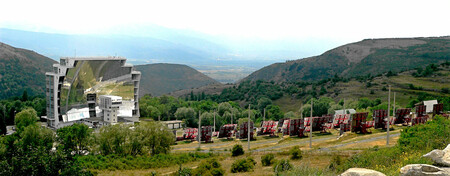
The Odeillo Solar Oven: A Marvel of Solar Technology
In the heart of the French Pyrenees lies the incredible Odeillo solar oven, a remarkable installation renowned for its immense capacity to concentrate sunlight. With capabilities that allow it to reach temperatures of up to 3,500 °C, this facility represents a pinnacle in solar technology and thermal energy generation.
A Look at the Great Solar Oven
The Odeillo solar oven, located in Font-Romeu-Odeillo-Via, stands as one of the two largest solar ovens in the world, along with Parkent in Uzbekistan. The installation features a monumental curved mirror, measuring 54 meters high and 48 meters wide, composed of about 9,000 facets. This sophisticated design enables the oven to amplify sunlight intensity by as much as 10,000 times, achieving staggering temperatures in the process.
The solar oven’s setup is both ingenious and complex. It employs a system of 63 motorized flat mirrors that follow the sun’s path throughout the day, directing concentrated sunlight to a large, fixed parabolic reflector. This reflector, covering an area of 1,830 square meters, focuses the light onto a focal point no larger than 40 centimeters in diameter, where it generates thermal power reaching one megawatt.
The Historical Background of Odeillo
The inception of the Odeillo solar oven dates back to the 1940s, initiated by chemist Félix Trombe, who, at the time, was experimenting with a reused anti-aircraft defense mirror to concentrate sunlight. The first prototype was constructed in 1949 in Mont-Louis, just a stone’s throw from the current site. Between 1962 and 1968, further enhancements led to the creation of the present oven, strategically placed in the sun-drenched region of French Cerdanya, which boasts a high number of sunny days annually and minimal atmospheric interference for optimal solar energy capture.
Key Features and Data
Let’s condense some notable metrics about this impressive solar oven:
- Main reflector height: 54 meters
- Parabolic mirror area: 1,925 square meters
- Rated thermal power: 1 megawatt
- Maximum temperature: 3,500 °C
- Solar concentration factor: 10,000 times normal solar radiation
The Significance of Odeillo
Since its inception in 1969, the Odeillo solar oven has served as a monumental leap towards harnessing solar energy for industrial applications. With a focus more on research than energy generation, it laid the groundwork for early solar tower plants, including the notable Thémis plant in the 1980s.
Today, the installation primarily focuses on two areas: the development of materials capable of withstanding extreme conditions for industries such as aeronautics, and pioneering research into solar fuels. A recent endeavor named Sunfuel exemplifies this, utilizing the intense heat from the solar furnace to produce alternative fuels by heating metal oxides to generate gases for conversion into clean fuels.
Is It Just a Curiosity?
While the Odeillo solar oven is a testament to engineering prowess and a precursor to the current solar energy boom, it is crucial to note that it is not an electricity-generating plant in the conventional sense. Its significant operational history does not contribute to current renewable energy outputs in the same way solar farms do today.
Comparative Insights: Odeillo vs. Parkent
Many often compare Odeillo with Uzbekistan’s Parkent, both of which are theoretical 1,000 kW solar ovens with similar operational capabilities. However, Odeillo edges out in efficiency due to its altitude and operational output, achieving a maximum power output of 1,000 kW compared to Parkent’s 700 kW, despite the latter featuring a slightly larger mirror.
In conclusion, the Odeillo solar oven stands not only as a remarkable engineering feat but also as a cornerstone in the journey toward sustainable energy solutions, proving that human ingenuity can harness the sun’s power in unprecedented ways.