
Tremor in Peru: A 4.8 Magnitude Earthquake Hits Chuquibambilla
Overview of the Earthquake
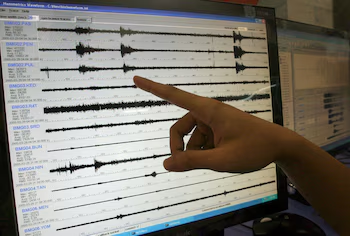
On July 1, 2023, a 4.8 magnitude earthquake struck the city of Chuquibambilla, located in the province of Grau, department of Apurímac, Peru. The earthquake was reported by the National Seismological Center (Censis) of the Geophysical Institute of Peru (IGP) at 3:39 p.m. local time. The seismic activity was detected 22 kilometers west of Grau at a depth of 74 kilometers.
Seismic Alerts and Data Collection
This event triggered a yellow alert, as classified by the National Seismic Network. The earthquake’s parameters—latitude and longitude of -14.14 and -72.91 degrees—signal a moderate level of seismic activity. The GPI CENSIS utilizes data from a comprehensive National Seismic Network integrated with diverse sensors that monitor speed, acceleration, and displacement throughout the country.
The color-coded alert system provides insights into the potential impacts of seismic events:
- Green: Magnitude less than 4.4
- Yellow: Magnitude between 4.5 and 6.0
- Red: Magnitude greater than 6.1
Understanding the Pacific Ring of Fire
Peru is situated in the Pacific Ring of Fire, a region renowned for its high seismic and volcanic activity. This area encompasses countries like Argentina, Chile, and Japan. Approximately 75% of the world’s volcanoes and 80% of the most powerful earthquakes originate from this zone.
The tectonic activity in Peru results from collisions between the South American tectonic plate and the Nazca plate. The friction from this interaction creates significant tension, releasing energy in the form of earthquakes and maintaining a landscape marked by constant volcanic activity.
The Impact of Earthquakes in Peru
The ramifications of seismic events in Peru can be severe, with a history of devastating earthquakes. Noteworthy incidents include:
- May 31, 1970: A 7.9 magnitude earthquake in Áncash caused approximately 67,000 fatalities and resulted in significant structural damage.
- October 3, 1974: An 8.0 magnitude earthquake affected Lima, leading to 252 deaths and 3,600 injuries.
- August 15, 2007: The Pisco earthquake (magnitude 8) caused 596 deaths and widespread destruction.
Safety Measures and Preparedness
In light of Peru’s seismic vulnerability, the government established the National Institute of Civil Defense in 1972 to develop preparedness plans and conduct drills. Awareness and readiness play crucial roles in minimizing the impact of future earthquakes.
Conclusion
The recent earthquake near Chuquibambilla serves as a reminder of Peru’s positioning within a seismic hotspot. Understanding the geological forces at play and enhancing community preparedness can significantly mitigate the risks associated with such natural events. Awareness of historical earthquakes can inform current safety practices and inspire resilience in the face of future tremors.