
Vivatech was held last week. It is one of the largest technology fairs in the world and one of the least concrete. There are humanoid robots, robots that are only dedicated to doing funny things, robo-assistants, artificial intelligence, beauty products, a quantum computer, virtual reality, and even a feelings monitor. Yeah.
However, what surprised me most was not the glimpse into the future, but the deployment of the Taiwanese Foxconn. When we talk about Taiwan and technology, TSMC is the name that most easily comes to mind, but Foxconn is the main component manufacturer worldwide, the engine of Taiwan’s exports and the controversial assembler of products such as the iPhone or the Xbox.
The point is that Foxconn wants to stop being the largest telephone assembler to become one of the main multinationals in the world, and its path is clear: robots, cars, and artificial intelligence.
Vera Rubin: The Jewel in the Crown
Nvidia is currently a driving force for many companies, and Foxconn has been one of the last to enter under the umbrella of the American giant. The company led by Jensen Huang already has everything ready so that those who manufacture its platforms can have the machines at maximum production for Vera Rubin.
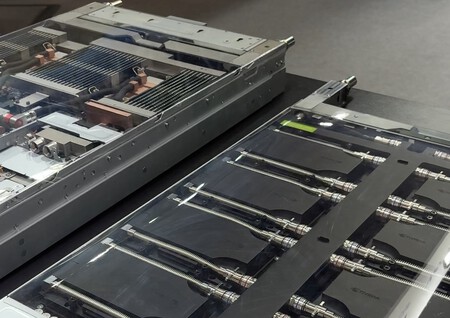
Two of the modules of a server
This is the new AI platform that promises to be at the forefront of training but also from the inference in the models, and Foxconn recently joined as one of the main suppliers of both Groq 3 LPX and the Vera Rubin NVL72 cabinets.
These cabinets are one of the grails of data centers, a liquid-cooled supercomputer in which 72 Blackwell GPUs and 36 Grace GPUs behave as a single large accelerator to train and infer trillion-parameter models.
It is an impressive platform that could be seen at the Vivatech stand next to one of the modules behind glass and signed by Huang himself.
You can see that Foxconn is proud of this, wow, but apart from the injection of money, also because of the possibilities it opens up for them as a company that wants to start doing everything.
Robotics and Digital Twins
To become multidisciplinary, one must now be an AI company. And something that goes hand in hand are robots and digital twins. At the fair, we couldn’t see much about this, although they did show a couple of glimpses.
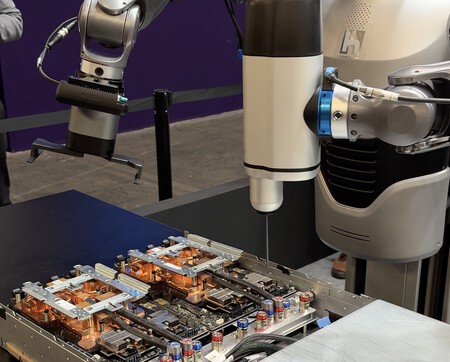
One example is a humanoid robot (from the hips up) that is responsible for setting up servers. He places pieces and screws them with the necessary precision and force so that everything is adjusted to the millimeter. They told us that it is not the fastest at work (of course) but in the end, there are still many of these working in parallel.
On the other hand, digital twins. This technology is intriguing because it is a software simulation of elements of the physical world, allowing engineers to develop exact replicas of the physical world in a virtual environment.
Imagine a car, for example, not only modeled to the millimeter with all its parts in software but that software simulates the weight of each of the components. This innovation accelerates developments in the real world.
Data Centers: Essential Infrastructure
If you want to have computing power without depending on increasingly expensive GPU rentals, possessing a data center is essential. This opens the door to both meeting internal needs and offering your equipment to others.
Within the framework of Vivatech, it was reported that the French electricity company Schneider had signed a collaboration agreement with Foxconn to set up a data center.
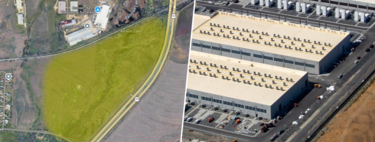
It is a partnership that makes perfect sense since one provides the energy while the other provides the AI platforms being developed for Nvidia itself.
Automotive Ventures: Driving the Future
If each leg of the business makes sense on its own, the unifying point is the most striking product they displayed at the fair: cars.
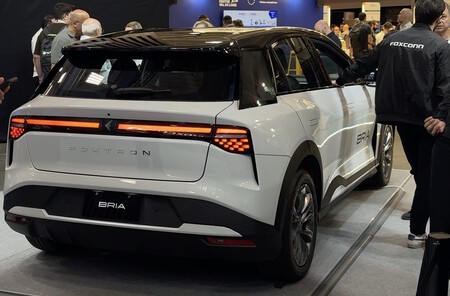
Electric Car Model
In 2020, Foxconn introduced Foxtron, a subsidiary focused on manufacturing electric vehicles under the open platform MIH. This platform has been dubbed “the Android of electric cars” since it combines a modular chassis, power electronics, and software, enabling third parties to build their own models and services.
At the French fair, they showcased two models, the Bria (an SUV) and the Model D (more of a van), both notable for their advanced interior screens and aerodynamic designs. The Bria, for instance, has about 300 to 350 km of autonomy (depending on driving conditions) and is powered by chips from MediaTek and Nvidia for enhanced features.
Final plans? They aim to bring these vehicles to Europe within a couple of years, navigating regulations and other challenges.
Ultimately, the electric car symbolizes Foxconn’s strategy to expand across diverse sectors, shifting from assembly to leading in AI platform manufacturing, robotics, digital twins, and data centers, all culminating in a complex and ambitious product like a car.