
The Open Wound: A Cultural History of the U.S.-Mexico Border
Introduction to the Borderlands
The Rio Grande, or Rio Bravo del Norte as it’s known in Mexico, marks the boundary between two nations. However, this line is a mere illusion—a violent simplification of the complex reality where people have lived for thousands of years on both sides of the river. The land embraced by this river does not recognize such divisions, nor do most of its inhabitants.
Complexity of Southern Texas
Southern Texas is a region that resists easy classification. Ask any ten residents what Southern Texas is like, and you will get ten different responses, colored by languages, loyalties, and histories. A rancher from Laredo will share a different perspective compared to a schoolteacher from Edinburg or a novelist writing in Spanish versus a journalist in English. Each viewpoint contributes to the intricate tapestry that is Southern Texas, but alone, none is complete.
Historical Context
The rich history of Southern Texas, fraught with themes of conquest, colonization, migration, and cultural clashes, requires a deep understanding of who has lost and who has gained. From the history of the coahuiltecan peoples, who have lived in the area for over eleven millennia to the catastrophic consequences faced by indigenous communities after European contact, the region has a deeply embedded narrative that cannot simply begin with the dates of 1836 or 1848. These events only mark certain turning points, beginning a story that’s much larger and much older.
Influence of Spanish Culture
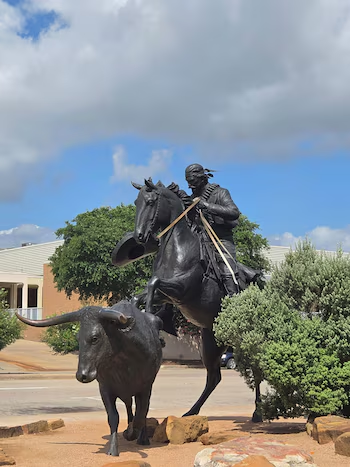
Spain established a lasting culture in Southern Texas through its extensive land grants in the 18th and early 19th centuries. This laid the foundation for cattle ranching, which would define the region for centuries, giving rise to the traditions and language still in use today. Terms like lasso, corral, and rodeo are derived from Spanish, linking the cultural legacies of both Mexican and Texan identities.
Key Historical Events and Their Impact
Two crucial, defining moments for the cultural landscape of Southern Texas are the Texas Revolution of 1836, which established the Republic of Texas, and the Treaty of Guadalupe Hidalgo in 1848, which ended the Mexican-American War. This treaty promised the protection of civil rights for Mexicans who remained in territory ceded to the United States, yet it quickly became a mechanism for legal dispossession. The Texas Rangers, often mythologized as heroes, acted with impunity against Mexican Americans, further complicating an already tumultuous historical narrative.
Literary Reflections and Cultural Response
Literature from this region reflects the complexity of its history and community. Writers like Américo Paredes and Tomás Rivera explore themes of identity, migration, and survival. Paredes, in his seminal work With His Pistol in His Hand, humanizes the struggle of the borderlands through the narrative of Gregorio Cortez, a figure celebrated in corridos—ballads that serve as both news and cultural memory. Rivera’s fragmentary novel Y la tierra no se lo tragó reveals the harsh reality of migrant life, emphasizing how geography can entrap or liberate.
Modern Narratives and Ongoing Issues
Contemporary authors like Valeria Luiselli are now documenting the ongoing crises at the border, particularly the impact on undocumented children. Their work emphasizes the need for a nuanced understanding of the borderlands as a space not merely defined by lines but by the people who constantly navigate and renegotiate identities within this territory.
Conclusion: Accepting the Complexity
Understanding Southern Texas requires embracing contradiction and recognizing that the narratives of the land and its people do not easily conform to binary divisions. The river may draw lines on a map, but its waters continue to flow, attesting to a history of survival, cultural resilience, and ongoing struggle. The rich and enduring narratives of the people living along this “wound” complicate any straightforward understanding of borders, inviting us to reconsider how we represent, narrate, and engage with this unique region.