
The television market in Spain had one of its worst years in 2025. According to Haier, Spaniards bought 15% fewer televisions than the previous year, and manufacturers accumulated so much unsold stock that the gap between what they put in stores and what people actually bought touched 30%. A drama.
In this context, the Chinese manufacturer, which has been competing in the TV market in Spain for just three years, closed the year with a growth of 15%. As 2026 unfolds, many eyes are on the television market, especially with the World Cup providing a substantial sales catalyst. Everyone is making efforts to recover lost ground.
Haier intends to continue its growth trajectory, and its new televisions for 2026 clearly demonstrate that their strategy is pivoted on two main pillars: screens of up to 115 inches and MiniLED technology. Javier Juristo, director of Haier’s TV business unit in Spain, encapsulates their strategy with a simple but powerful statement: “Our mission is not to fight for price.”
Haier Reads the Market Backwards
Haier wants to communicate that its growth is not an anomaly but rather a reflection of effectively reading the market. They operate on a straightforward premise: in the TV landscape, the victor is no longer the one who offers the lowest price but the one who delivers a more appealing proposition in terms of image quality, sound, size, and connectivity.
Juristo has distinguished Haier from other Chinese manufacturers, stating that they not only hold the top position in China but also in the United States, where they made headlines by acquiring General Electric a decade ago. The European market, however, is more complex due to varying consumer habits, prompting Haier to expand gradually. After introducing their TVs to Spain in 2023, they decided to venture further into the Portuguese, Italian, Polish, French, and UK markets in 2026.
Haier emphasizes that their competition is not based on price, but rather on competing in the mid-high and premium segments. This approach positions them in a less crowded space, making them less vulnerable to price wars—particularly crucial given the current environment where rising component costs are expected to complicate matters. “A busy end of the year is on the horizon,” confesses Juristo.
The Haier TVs of 2026, at a Glance
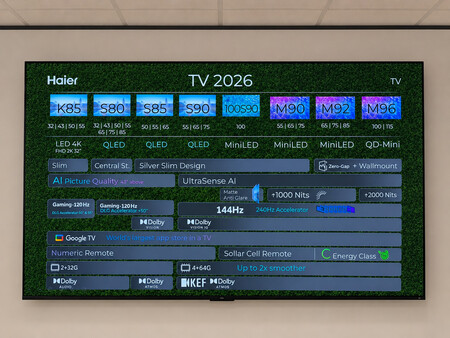
Haier has arranged its 2026 lineup in an accessible manner, spanning from introductory models to larger sizes without any unnecessary complexity. Here’s a brief overview of what each series offers:
The K85 serves as the entry point. This 4K LED model ranges from 32 to 55 inches, incorporating Google TV, Gemini, and a new MediaTek processor. While it’s not designed to dazzle, it makes clear that even budget models come equipped with smart features. Prices start at €399 but are currently available for €329.
The S80 targets the general public, offering a vast range of sizes from 32 to 85 inches. This is Haier’s most extensive QLED series, aiming to cater to virtually everyone. With a sleek design, Dolby Vision, and various size options, it effectively meets diverse consumer needs. The 50-inch model is priced at €519, with offers starting at €429.
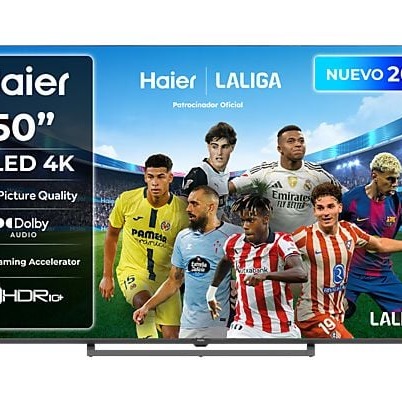
QLED TV 50″ – Haier S80G Series H50S80GUX, QLED 4K HDR10, Google TV, AI Picture Quality, Gaming 120Hz, Black
The price could vary. We earn commission from these links
The S85 refines its focus on 50, 55, and 65 inches, sitting squarely within the most competitive market segments. It features voice control with Gemini, providing an added layer of convenience. The 50-inch model is priced from €559.
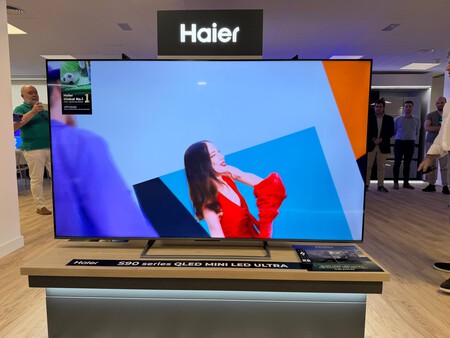
The S90 transitions into premium territory, featuring a QLED panel coupled with KEF sound technology, a reputable British audio brand known for its expertise in high-fidelity sound systems. Available in sizes of 55, 65, and 75 inches, the S90 meets the demands of more discerning consumers. The 55-inch model starts at €729, though current promotions allow for prices around €599.
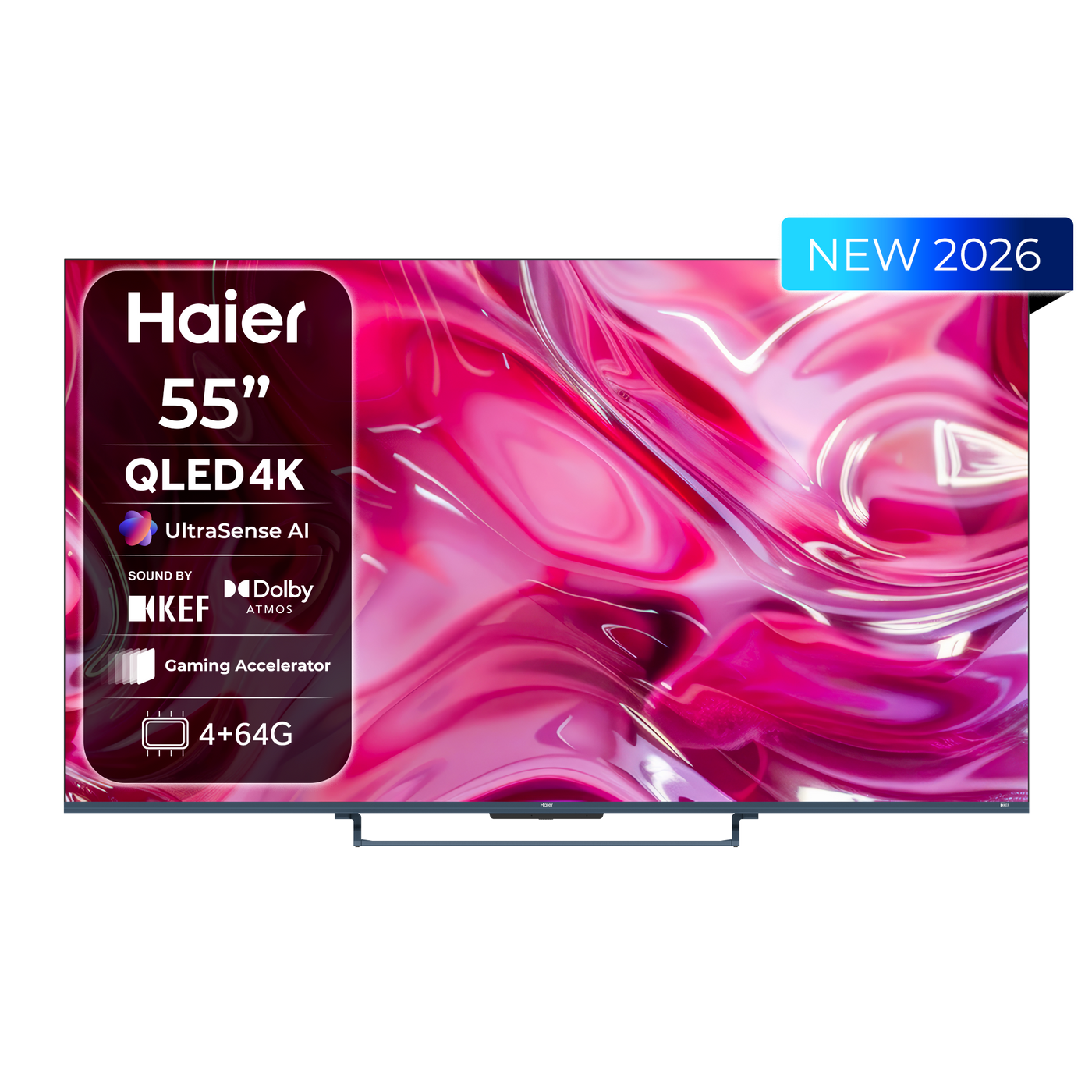
S90 Series – QLED, 55 screen size, Google TV, 4K resolution
The price could vary. We earn commission from these links
Next is the MiniLED collection, including the M90 and M92, designed for premium performance. Featuring heightened brightness and contrast levels, these televisions incorporate UltraSense AI, an intelligent layer that dynamically adjusts settings, along with KEF sound and Zero Gap design, which minimizes the gap between the TV and wall for a sleek aesthetic. The 75-inch M92 model starts at €1,699, currently available for €1,399.
At the top of the lineup is the M96, which boasts sizes of 100 to 115 inches, catering to a more elite market segment. The 100-inch model begins at €2,849 but is promoted for €1,999 on the website.
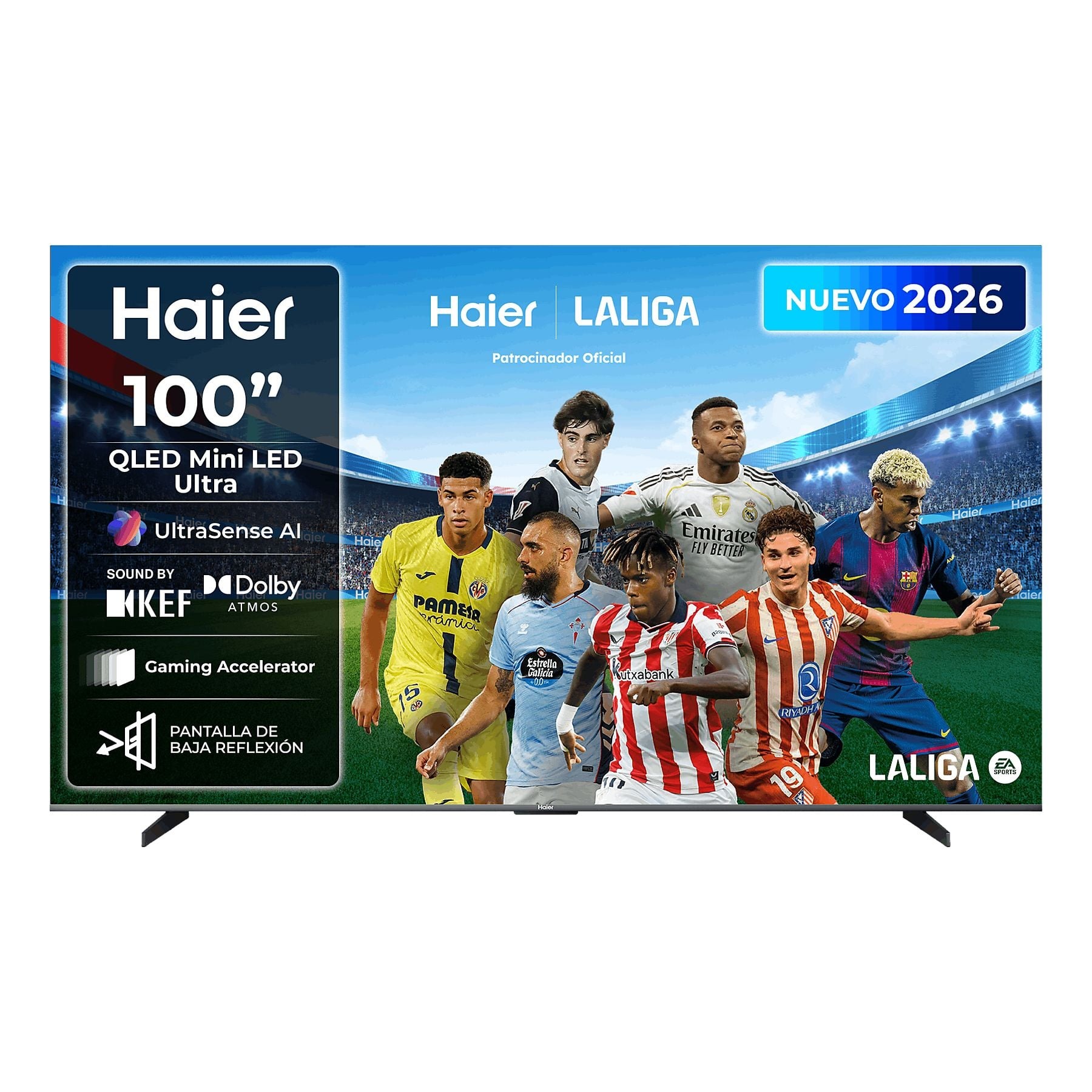
100″ Mini-LED TV – Haier S90 Series H100S90FUX, 4K, Google TV, Dolby Atmos, KEF Sound, Gaming 144Hz, Black
The price could vary. We earn commission from these links
SERIES | PANEL | INCHES | STRONG POINTS |
|---|---|---|---|
K85 | 4K LED | 32, 43, 50, 55″ | Entry range with Google TV and Gemini |
S80 | QLED | 32, 43, 50, 55, 65, 75, 85″ | Slim Design, Dolby Vision |
S85 | QLED | 50, 55, and 65″ | Dolby Vision, Dolby Atmos |
S90 | QLED | 55, 65, and 75″ | KEF sound, 144 Hz, and voice control |
100S90 | Mini LED | 100″ | Matte anti-reflective screen and solar control |
M90 | Mini LED | 55, 65, 75, and 85″ | UltraSense AI and KEF sound |
M92 | Mini LED | 65, 75, and 85″ | Zero Gap design and wall mount included |
M96 | QD-Mini LED | 100 – 115″ | Flagship, large format, and KEF sound |
C9 (2025) | OLED | 55, 65, and 77″ | Harman Kardon sound |
Big Inch, MiniLED, and a Lot of AI
The introduction of new TVs for 2026 emphasizes larger sizes, smart integration, and enhanced features. Haier reaffirms its commitment to LED, QLED, and QD-Mini LED Ultra technologies, with a particular emphasis on MiniLED in their oversized models. This strategy aims to cater to a broad audience, ensuring brightness, contrast, and quality finishes across all tiers.
Large screen sizes are a focal point, reflecting the company’s belief in market trends towards bigger displays. Their intentions are backed with compelling features, like the Zero Gap design, which minimizes visible space between the TV and the wall, making large televisions a viable option for modern living rooms.
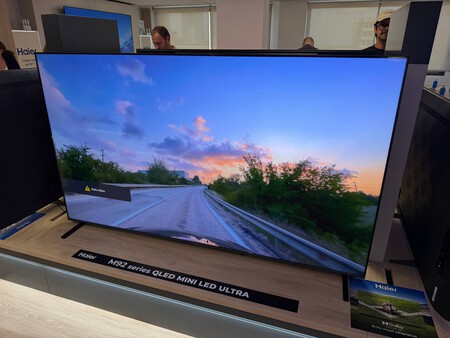
Moreover, the innovative UltraSense AI serves as an integral feature across their lineup, enhancing everything from visual settings to sound control. The technology automatically adjusts image settings based on scene detection, optimizes for 4K upscaling, and adapts gameplay visuals and sound to elevate the viewing experience.

Connectivity remains central to Haier’s strategy. With the incorporation of Gemini in nearly all models and Google TV as a backbone, voice control becomes accessible, particularly in models like the S85. The company also leverages its hOn app to connect various devices seamlessly, enhancing the user experience further.
Another crucial tech layer includes MediaTek processors, which are deployed across most of their TVs, from the 700 series onward. All panels are designed for optimal contrast and visual quality, complemented by Low Blue Light technology to enhance user comfort during prolonged use.
What About OLED and Micro RGB?
Haier has not renewed its OLED range for 2026, meaning the existing lineup consists of models from 2025. Juristo explained that they chose to prioritize advancements in LED, QLED, and Mini LED technologies before refining their OLED offerings—a highly competitive field. New OLED models are anticipated for announcement later this year, with a launch expected in spring 2027.
As for Micro RGB technology, Haier is set to showcase its initiative for this at IFA 2026 next September, staying aligned with industry trends.
—
In Xataka | RGB, MiniLED, OLED and QLED TVs: the Best TVs to Watch the 2026 World Cup Matches at Home