
Remembering Borges: A Tribute in Geneva
A Gathering in Plainpalais Cemetery
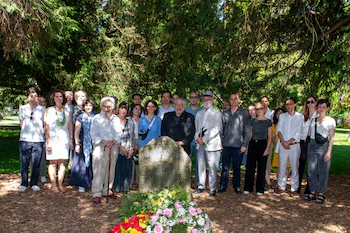
On a serene Sunday in Geneva, the 40th anniversary of Jorge Luis Borges’s passing was marked by a poignant gathering at the Plainpalais cemetery. The floral tributes, particularly the yellow roses that fell on Borges’s grave, served as a vibrant reminder of the enduring legacy left by one of Argentina’s most celebrated authors. The event drew around 30 people, including notable literary figures such as author Alberto Manguel and Borges expert Annick Louis.
A Unified Tribute
The gathering was organized by Alejandro Roemmers and Alejandro Vaccaro, members of the Swiss association Los Conjurados, dedicated to promoting Borges’s work. Representatives from the Argentine Embassy in Switzerland and the city of Geneva attended, underscoring the communal respect for Borges’s contributions to literature. The attendees shared a collective purpose: to honor a legacy that has transcended boundaries and continues to inspire readers globally.
Reflecting on Borges’s Life
Marcos Liyo opened the event with reflections on Borges’s life and work. He recounted Borges’s contemplative words from a 1980 poem, pondering where he might die, years before he passed away in Geneva. The gathering transformed into a heartfelt sharing of poetry. Roberto Alifano, Borges’s scribe during his later years, recited a haiku dedicated to the prolific writer, reminding everyone of the intimate bonds formed through literature.
Contemporary Connections
Raul Tola, director of the Vargas Llosa Chair, shared his initial apprehension about Borges’s work due to its contradictions with his own literary beliefs. Yet, he found solace and inspiration in Borges’s writings, encapsulated in a poem rich with emotions. Annick Louis, teaching in France, added her voice, illustrating the universality of Borges’s themes while reading in French—emphasizing oblivion and memory, central to Borges’s philosophy.
A Dialogue Between Past and Present
The event also attracted individuals who connected to Borges through personal narratives. Among them was an Argentine psychoanalyst who had left her country during the dictatorship, finding solace in Borges’s words that bridged their past to the present moment in Switzerland. This human connection highlighted how Borges’s writings resonate on individual, emotional levels.
The Living Voice of Borges
As the tribute climaxed, a recording of Borges reading his poem “Everness” echoed through the cemetery, reminding everyone of the inherent connection between language, memory, and existence. The final lines resonated deeply: “There is only one thing there is not. It is oblivion.” This poignant moment encapsulated the essence of the gathering—Borges had not been forgotten, and his influence remained vibrant and alive.
Conclusion: A Legacy Eternal
Forty years after his passing, Borges’s words continue to inspire discussions, memories, and emotions. The event in Geneva served as a testament to his timeless relevance and the shared love for literature that bridges generations and geographies. As yellow roses fell, it was clear: indeed, there is no forgetting.