
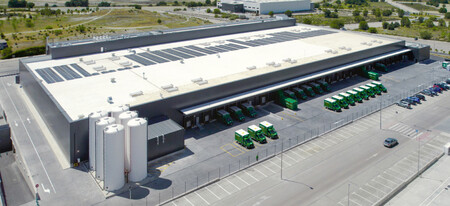
Mercadona’s Digital Transformation: The Semi-Automated Hive
Spanish supermarket giant Mercadona is evolving beyond its traditional offerings of white label and pre-cooked foods. While it is enriching store experiences by converting sections into ‘mercaurantes’—dining spaces where customers can enjoy in-store cooked meals—the company is equally focused on enhancing its online shopping experience. With a reported revenue of 1.1 billion euros from its online channel in 2025, it has unveiled a groundbreaking new logistics facility in Madrid aimed at revolutionizing remote shopping.
The Emergence of the Semi-Automated Hive
The new warehouse, dubbed the “Semi-Automated Hive,” is set in the La Atalayuela industrial estate in Villa de Vallecas, Madrid. This facility is a game changer, marking a significant shift in how Mercadona operates its online sales channel. While the chain boasts six other warehouses located primarily in Valencia, Barcelona, and Seville, none are as advanced as the Vallecas facility.
Features That Set It Apart
This state-of-the-art warehouse is unique because it combines automation with human oversight. Unlike previous facilities that relied heavily on workers and basic machinery, the Vallecas Hive incorporates 70 robots to manage the retrieval of 2,700 non-perishable goods. This means that employees no longer have to navigate aisles to find products; instead, items are delivered directly to order preparation stations.
Size and Capacity Considerations
The scale of this warehouse is impressive, covering approximately 32,000 square meters, making it the largest of its kind within Mercadona’s network. The investment of 54 million euros and the employment of roughly 700 staff aim to foster efficiency, allowing the facility to handle up to 5,000 orders per day. Combined with existing warehouses, this increases capacity in the Community of Madrid to 8,000 orders daily, targeting a service coverage of 95% within the region.
Strategic Significance of the Hive
This investment is not merely about infrastructure; it represents a strategic pivot for Mercadona. Historically, the chain has focused on its white label offerings and the ‘Ready to Eat’ segment, which generates substantial revenue. In the past year alone, the projected turnover from prepared meals reached 700 million euros in Spain, growing to 3 billion when including operations in Portugal.
A Focus on Online Sales
While the online channel does feature a selection of prepared dishes, the bulk of sales occur in physical stores. The Semi-Automated Hive is geared specifically toward enhancing online sales, a sector showing promising growth. In Mercadona’s latest annual report, a surge of 26% in online revenue indicates the effectiveness of their reinforced digital presence, surpassing 1 billion euros.
Recent Enhancements to Online Shopping
In addition to launching new warehouses, Mercadona has made significant strides by optimizing its website for accessibility, ensuring that it caters to customers with vision impairments. Furthermore, the addition of Bizum as a payment option enhances the user experience, streamlining online transactions.
In conclusion, Mercadona’s venture into semi-automated warehousing not only showcases its commitment to embracing technology but also highlights its strategic focus on capturing the growing online retail market. As consumer preferences continue to shift toward convenience and remote purchasing, Mercadona is well-positioned to lead in this competitive landscape.