
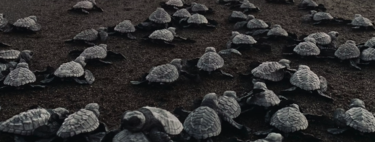
The Sahel: A Region at Risk
The Sahel is a critical ecological region that serves as the boundary between the Sahara Desert and the lush African savannahs. Unfortunately, it is becoming increasingly arid, with the United Nations Convention to Combat Desertification (UNCCD) warning of its vulnerability to desertification. This phenomenon results in hardened soils that hinder water penetration and inhibit plant growth, prompting migration in search of more viable living conditions.
A Unique Solution: Turtles, Not Trees
The traditional response to combat desertification has predominantly focused on reforestation, a method that is costly and often ineffective. Innovative approaches are now required, and researchers have proposed a revolutionary idea: instead of reintroducing vegetation, why not reintroduce a native animal whose natural behavior positively influences soil structure?
In 2021, a dedicated research team released 500 African spurred tortoises (Centrochelys sulcata) in the southern edge of the Sahara. Remarkably, five years later, satellite imagery revealed that areas previously dominated by sand now exhibit green patches of vegetation.
The Role of African Spurred Tortoises
What do these tortoises do that make them so effective? They dig. This species constructs burrows that can reach up to 15 meters in length, a natural instinct to find cooler or warmer environments. This digging activity breaks up the hardened soil crust, allowing water infiltration and creating optimal conditions for seeds to germinate.
Why Tortoises Matter
Termed “ecosystem engineers,” African spurred tortoises significantly contribute to their surroundings by modifying the environment in ways that benefit other species. The UNCCD highlights land restoration as one of the most effective solutions to counteract desertification. Interestingly, tortoises perform this vital role autonomously, without the need for human intervention or machinery. For local communities, digging to create water-retaining holes is labor-intensive, but tortoises accomplish this as part of their natural behavior.
Challenges Facing the Species
Ironically, while the African spurred tortoise is native to the Sahel, its population is declining due to various threats, including habitat loss and exploitation for the pet trade. The decline of this tortoise not only jeopardizes biodiversity but also exacerbates soil degradation, making it even harder for plants to thrive.
The Context of Desertification in Africa
Desertification is not a new issue; as early as 1977, the first United Nations Conference on Desertification was held in Nairobi, Kenya. Currently, two-thirds of Africa is classified as arid or desert land, with significant portions experiencing degradation.
Enhancement of Soil Ecology
The ecological mechanism behind the tortoise’s digging provides essential benefits. By breaking up the hardened soil, the tortoise allows rainwater to penetrate deeper layers, enhancing soil porosity, reducing surface temperature, and making nutrients more available. This improvement enables seeds that may have previously been unable to germinate to prosper.
Moreover, the excavated areas attract insects and microorganisms, igniting an ecological chain that ultimately helps recover biodiversity, albeit with limited vegetation.
Conclusion: A Starting Point, Not a Miracle
While the reintroduction of tortoises is a promising initiative, it’s crucial to understand that this is just a starting point. For the desertification process to reverse, additional factors such as adequate rainfall and sustainable management practices are essential. Introducing tortoises will be futile if they remain threatened due to hunting or habitat destruction. Furthermore, ongoing studies suggest that tortoises could also play a role in seed dispersal, thereby contributing to the greening of the Sahel beyond simple excavation.