
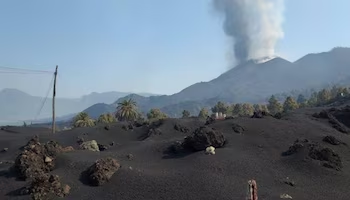
Microbial Communities in La Palma’s Lava Tubes
An international research team has made a groundbreaking discovery by identifying microbial communities inhabiting the lava tubes formed after the 2021 eruption of the Tajogaite volcano in La Palma. This study, published in the journal Environmental Microbiome, provides a natural model to explore the potential for life on Mars. Collaborators include the Institute of Natural Resources and Agrobiology of Seville (IRNAS-CSIC), the Geological and Mining Institute of Spain (IGME-CSIC), the University of Almería, and others from Portugal and the Canarian Federation of Speleology.
Observing Life in Extreme Conditions
Monitoring of these lava tubes commenced one to two years post-eruption, enabling scientists to observe how life arose in a completely new and sterile environment. As noted by the Junta de Andalucía, the lava tubes present a ‘newborn world’ where the initial living organisms must pave the way for the ecosystem’s development.
Sampling Campaigns and Findings
The research team conducted three extensive sampling campaigns in extreme conditions, with air temperatures reaching up to 60 degrees Celsius and rock surfaces exceeding 90 degrees. The findings reveal that these harsh conditions have created a natural laboratory for exploring biological limits and adaptation mechanisms.
The Origins of Microorganisms
To trace the origins of the first microorganisms, the researchers employed DNA analysis combined with mineral studies and environmental assessments. They discovered that most microorganisms were transported from external sources as aerosols or spores, or came from animals like birds and rodents, introducing organic matter into the sterile environment and facilitating the emergence of biological communities.
Transformative Role of Microorganisms
The research highlights that these microorganisms not only inhabit but actively transform their environment. Through forming biofilms on rocks, they alter mineral composition and initiate processes essential for fertile soil development and ecosystem evolution. Factors such as temperature, salinity, and mineral content greatly influence which species establish and thrive in these volcanic environments.
Implications for Astrobiology and Earth Sciences
This study draws intriguing parallels between the colonization process observed in La Palma and potential occurrences on other volcanically active planets like Mars. The results foster new research avenues regarding extraterrestrial habitability while also shedding light on ecological recovery following extreme events on Earth. Additionally, the implications of these findings may extend to the realms of healthcare and biotechnology, marking a significant development for both planetary science and terrestrial ecology.
*With information from EFE