
Alito Moreno’s Vision for the 2030 PRI Presidential Candidate
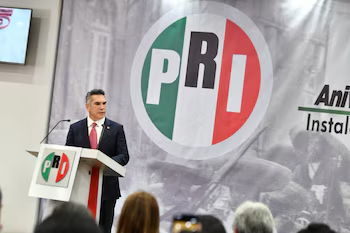
Alejandro “Alito” Moreno, the national president of the Institutional Revolutionary Party (PRI), has made a bold statement about the party’s direction leading into the 2030 presidential election. He firmly rejects the notion of presenting a candidate unconnected to the party’s core values, emphasizing the need for genuine political representation that resonates with the electorate.
The Dismissal of Citizen Candidacies
Moreno argued that the PRI would not consider a candidate from outside its ranks, positioning this stance against the backdrop of past electoral defeats. In press statements on June 9, he pointed out that the PRI has faced significant challenges in both the 2018 and 2024 elections without a candidate rooted in its own foundation. He criticized the strategy of relying on citizen candidacies, which he claims have proven ineffective. Moreno referenced the 6.7 million votes received by the party under these circumstances as evidence of the necessity of a dedicated partisan candidate.
Prioritizing Efficiency Over Perception
Moreno’s central thesis is that the electorate seeks efficiency and problem-solving abilities in leadership, rather than merely an image of honesty or integrity. He questioned the validity of the common belief that voters prioritize candidates who appear morally upright. “What people want today is who can solve the issues of the country,” he asserted. This provocative statement challenges the traditional narrative of politeness and rectitude in political campaigns, shifting the focus instead to tangible results.
Critique of External Voices
In his address, Moreno also took aim at what he referred to as external voices pushing for non-partisan candidates. He criticized commentators, analysts, and businessmen for propagating the notion that political parties are inherently corrupt. Moreno suggested that these external viewpoints misinterpret the public’s desires and needs, arguing that the PRI must acknowledge its historical foundation and core values while being pragmatic about leadership choices.
The Consequences of Recent Elections
Reflecting on the last two electoral processes, Moreno did not hold back in his assessment of the outcomes. He used colloquial expressions to describe the losses, underscoring the need for a strategy that aligns more closely with the party’s identity. He stated, “If you believe that we are going to go again with another invention to the 2030, do you believe that? No, friends, I’m not going to do that,” thereby dismissing any repeat of the past strategies that did not yield fruitful results.
The Resignation of Erubiel Alonso
Adding to the backdrop of the PRI’s internal challenges, Deputy Erubiel Alonso recently announced his resignation after 30 years of party affiliation. In a heartfelt address, Alonso expressed gratitude to the party while highlighting his desire for a personal evolution, which he believes will lead him to contribute not as a party member but as an open participant in political discourse.
Conclusion: The Road Ahead for PRI
As the PRI looks toward 2030, Alejandro Moreno’s emphasis on a candidate grounded in the party’s core values raises questions about the future of political representation in Mexico. His rejection of past strategies, combined with a focus on pragmatic problem-solving, signals a shift in how the party might approach the upcoming election. The landscape is uncertain, but one thing is clear: the PRI aims to redefine its identity in a rapidly changing political environment.