
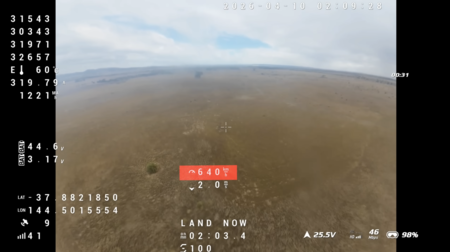
When we think of a drone, we normally imagine a device that takes off vertically, remains suspended in the air, and allows us to record stunning aerial shots. However, the Blackbird is changing the narrative. This drone is not about capturing beautiful vistas; its objective is much more extreme: to fly as fast as possible. In this race for speed, flight stability plays a lesser role compared to achieving high velocities, and recent modifications to its propellers have drastically boosted its performance.
The Current Record Holder
The official speed record for drones is still held by Luke Bell and Mike Bell. According to Guinness World Records, they reached an astonishing average speed of 408.60 mph (657.59 km/h) on December 11, 2025, with the Peregreen V4 in Cape Town. This wasn’t a one-off success either; the father-son duo had previously established this record in 2024 with a speed of 480 km/h and again in June 2025 with 580 km/h.
The Blackbird’s Groundbreaking Attempt
Pitting the Blackbird’s attempt against this impressive benchmark reveals its significance. Ben Biggs and Aidan’s drone reportedly reached a staggering speed of 453 mph (approximately 730 km/h) during a test pass. While this figure is undoubtedly eye-catching, it’s crucial to add context. This performance is labeled as an unofficial demonstration, raising questions about its validity and repeatability under verified conditions.
Understanding the Numbers
The nuance here lies in how the speed was achieved. The 730 km/h pass benefited from a tailwind of 54.7 km/h, meaning the estimated airspeed actually dropped to 674 km/h. On an upwind pass, the drone clocked around 640 km/h. Hence, the average speed of about 684 km/h offers a more realistic measure of the drone’s capabilities, outweighing the peak speed when assessing the project’s success.
The new propellers play a pivotal role in pushing the boundaries of speed. Made from carbon fiber, these blades have a higher pitch angle, making them more efficient at high speeds. However, they come with trade-offs: at lower velocities, they struggle to generate thrust, causing the motors to exert more effort on takeoff.
The Innovative Propeller Design
Another fascinating aspect of the Blackbird’s design is the serrated leading edge of the propellers. This unique shape creates small vortices that optimize airflow around the blades, enabling air to exit backward rather than laterally. This design stabilizes the boundary layer—the thin film of air adhering to the propeller’s surface—that affects drag. It allows for steeper operational angles without sacrificing efficiency, transforming the propellers into efficient air movers rather than merely thrust generators.
Challenges Faced
Pushing a quadcopter to its limits isn’t without risks. During the testing, the Blackbird lost connection around 633 km/h, attributed to antenna geometry, the Doppler effect, and signal overload. The second challenge emerged during a hard landing, which resulted in damage to the drone when its batteries depleted just meters from the ground. Despite these setbacks, the Blackbird’s speed record is now on the map, pushing competition for future attempts.
With the current record still held by the Peregreen V4, the question looms: will the Blackbird team reach out to Guinness World Records for an official verification of their remarkable achievement?
Images | Drone Pro Hub