
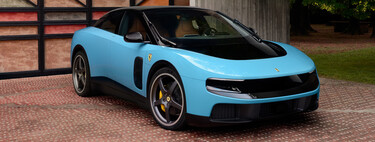
## The Ferrari Luce: A Bold Statement in Automotive Design
You either love it or hate it, but the Ferrari Luce has left almost no one indifferent. The firm’s first 100% electric car is a statement of intent—a commitment to the future that intentionally sheds much of its storied past. In this new era, one significant element stands out: the prominence of physical controls and the de-emphasis of screens in automobiles.
### Why Bad Design Can Be Lethal
In a recent interview, designer Jony Ive remarked, “people are dying because of bad design.” His insights raise critical questions about the safety implications of modern technology in vehicles. He argues that while multitouch technology is fantastic for mobile phones, it poses risks when utilized in cars. According to Ive:
> “Multitouch technology is wonderful for a mobile phone, because when you’re using a phone, you’re looking at that phone. But multitouch technology shouldn’t be in a car.”
This statement underscores the dangers of drivers diverting their attention from the road in an effort to interact with screen-based controls.
### Stop Looking at the Screen So Much
The concern is not merely theoretical. Ive points out that if drivers have to look at screens for basic functions like navigation or changing the music, they are less likely to focus on the road. This has been a recognized issue in the automotive world, with organizations like Euro NCAP factoring this into their safety ratings. Cars only achieve five stars in crash tests if essential functions—turn signals, emergency lights, horn, and windshield wipers—are controlled via physical buttons.
### Muscle Memory
The essence of the problem lies in “touch blindness.” Touchscreens compel users to focus their visual attention on the display, introducing significant hazards while driving. Physical buttons enable drivers to rely on muscle memory, allowing them to operate controls without diverting their gaze from the road.
### Multitouch Technology Is Not for Everyone or Everything
Ive notes that technology can be both beneficial and detrimental, depending on its application. In the case of the Ferrari Luce, the integration of touch technology was intentionally minimal. He explains:
> “I was very fortunate to be involved in the development of multitouch technology. It’s a fantastic technology that makes some new user interfaces possible, but it has to be used appropriately, thoughtfully, and carefully.”
### Result: Fewer Screens, More Touch
The interior of the Ferrari Luce symbolizes a shift away from digital dominance. The design showcases an abundance of physical controls, rotary dials, switches, and buttons. While screens are still present, the emphasis is clearly on tactile interaction over visual dependence.
### This Is About Being Better
Ive articulates a clear vision: “just because the power source is electrical, one seems to assume that the interface should be digital… I think that thinking is presumptuous.” From its inception, the designers and engineers behind the Ferrari Luce focused on developing solutions that prioritize safety and usability, not merely being different or cutting-edge. Their mission is to address longstanding automotive issues in new, better ways.
In conclusion, the Ferrari Luce is more than just an electric vehicle; it represents a thoughtful departure from the burgeoning trend of touchscreen controls. By emphasizing physical interaction, it aims to enhance the driving experience while prioritizing safety—an essential consideration that too often gets overlooked in the era of advanced technology.