
Nördlingen: A Medieval Marvel in a Meteorite Crater
If you’re a fan of anime, the comparisons between Nördlingen and the fictional Shiganshina from Shingeki no Kyojin might ignite your imagination. While Nördlingen has become a pilgrimage site for enthusiasts, this historic German city nestled in the Donau-Ries district offers more than just visual parallels.
A Unique Geographic Setting
Nördlingen is not an ordinary Bavarian village but is rather a city steeped in history. In 1215, Emperor Frederick II elevated it to an imperial city of the Holy Roman Empire. The wall surrounding it, built a century later, captures a unique geological history; Nördlingen lies within the crater of a meteorite impact, which many assumed to be an inactive volcano until the 1960s.
The Nördlinger Ries, the crater in which the city is embedded, measures 24 kilometers in diameter and was formed by a meteorite approximately one kilometer wide that struck the Earth during the Miocene epoch. This catastrophic event generated immense heat and energy, leading to the obliteration of life within a 100-kilometer radius.
Historic Walls that Trace a Meteorite’s Outline
In 1327, Louis the Bavarian commissioned the construction of Nördlingen’s wall. Remarkably, the wall traces the exact diameter of the meteorite’s primary crater, a coincidence that would remain unnoticed until the 20th century. With a circumference of 2.7 kilometers, these walls represent one of the three main medieval defenses in Germany that remain largely intact today. The view from the Daniel tower reveals a perfectly circular city layout, a testament to both architectural ingenuity and geological phenomena.
Walls Embedded with Diamonds
Perhaps the most astonishing feature of Nördlingen is its walls—constructed using suevite, a unique and rare stone imbued with small diamonds. The meteorite’s collision with local graphite deposits produced an approximate total of 72,000 tons of diamonds, which are now hidden within the city’s masonry.
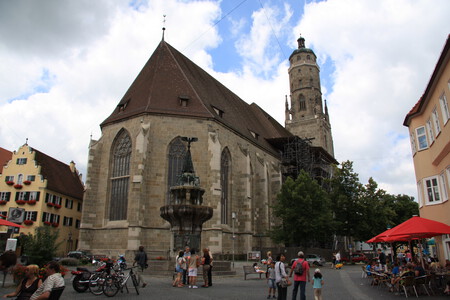
These buildings, unknowingly crafted from diamonds, shocked geologists only after the groundbreaking work of Eugene Shoemaker and Edward Chao in the 1960s, who identified shock quartz indicative of the impact event at St. George’s Church.
St. George’s Church. Photo by Tkx via Wikimedia
St. George’s Church: A Jewel in Architecture
St. George’s Church stands as one of the largest late Gothic churches in southern Germany, built between 1427 and 1505. Its walls, adorned with suevite, are uniquely embellished just like the jewelry found in altarpieces, creating a captivating blend of spirituality and geology. The church’s tower, named “Daniel,” rises to 90 meters. Climb its 350 steps for an unparalleled view of Nördlingen’s circular form and its geological significance.
Nördlingen: A Training Ground for Space Exploration
Interestingly, the geological features of Nördlinger Ries have made the area a suitable training ground for astronauts preparing for missions to the Moon and Mars. NASA’s Apollo astronauts studied the crater’s geology during their training, while the European Space Agency’s PANGAEA program continues to use it for astronaut training, alongside locations such as the Italian Dolomites and Lanzarote.
Conclusion
Nördlingen encapsulates a remarkable blend of history, geology, and the unforeseen beauty of nature’s aftermath. With its medieval charm and hidden diamonds, it presents not just a glimpse into the past but also a connection to extraterrestrial explorations. Whether you’re exploring its walls or overlooking the crater from the Daniel tower, Nördlingen is any traveler’s dream come true.