
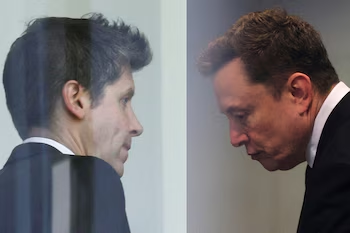
Elon Musk Loses Case Against OpenAI: A Legal Setback
A recent jury verdict in Oakland, California, marked a significant development in the legal battle between Elon Musk and OpenAI, the groundbreaking company behind the AI tool ChatGPT. The jury concluded that Musk’s claims were filed too late, granting immunity to OpenAI’s executives, including CEO Sam Altman and president Greg Brockman.
Jury Findings and Their Implications
The nine-member jury unanimously decided, after less than two hours of deliberation, that Musk’s legal complaints exceeded the allowed timeframe for filing such actions. This finding effectively absolves OpenAI and its leadership from the allegations Musk brought forth. Although the jury did not delve into the details of Musk’s claims, their ruling fundamentally benefits OpenAI.
Judge Yvonne Gonzalez Rogers remarked on the robustness of the jury’s decision, indicating confidence in their conclusion and suggesting that her final ruling would align with theirs.
Background of the Lawsuit
Elon Musk, who co-founded OpenAI in 2015, initiated the lawsuit in summer 2024. Musk accused Altman and Brockman of capitalizing on their initial investments in the non-profit entity to create a for-profit enterprise. He contended that the shift in OpenAI’s mission, particularly the advent of a profit-driven model in 2019, justified his legal action.
Musk sought not only to remove Altman and Brockman from their posts but also demanded compensation exceeding $150 billion for damages, asserting that these funds would be redirected to support non-profit endeavors.
OpenAI’s Defense
OpenAI’s legal team countered Musk’s accusations by highlighting his involvement in discussions regarding the company’s commercial transformation prior to his departure from the board in 2018. They alleged that Musk’s motives were conflicted, suggesting he aimed to merge OpenAI with Tesla or gain control of its new structure to attract investments.
The jury’s decision was pivotal—it indicated that Musk was aware of the relevant issues since 2021, thereby rendering his claims inadmissible.
Broader Implications for the AI Industry
While the lawsuit itself was a significant point of contention, its broader implications reflect the ongoing debates in the AI sector regarding profit versus purpose. Musk’s allegations posed existential risks to OpenAI, potentially undermining its financial standing amidst intensifying competition from tech giants like Google, Anthropic, and DeepSeek.
OpenAI, valued at approximately $730 billion, faced accusations from Musk of illicitly enriching its executives and securing partnerships with major corporations such as Microsoft. However, the recent ruling strengthens OpenAI’s position in this competitive landscape.
Conclusion
Musk’s legal challenges have opened up discussions on AI development models, contrasting the open-source vision against commercial pursuits. As Musk continues to develop his own AI lab, xAI, the tension between different leadership styles and operational philosophies in the AI industry is likely to remain a hot topic going forward. The recent ruling not only caps Musk’s ambitions but also solidifies OpenAI’s operations and future in the evolving landscape of artificial intelligence technology.