
Understanding the Password Landscape
As technology evolves, so does the importance of password security. Although we may transition to more sophisticated methods of authentication, checking your passwords remains crucial, especially for sensitive services like banking and email.
The Recurring Patterns of Weak Passwords
Every year, cybersecurity firms like NordPass reveal staggering statistics about the most commonly used passwords. An alarming number of individuals still rely on weak keys like “1234” and “123456,” which can be hacked almost instantaneously. This repetitive pattern underscores a troubling trend: many have yet to learn from past security breaches.
Most Common Passwords in Spain
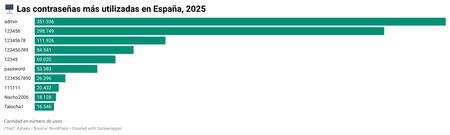
Spain reflects this global trend, with the list of weak passwords revealing no major surprises. According to NordPass, the top three passwords used in Spain are ‘admin’, ‘123456’, and ‘12345678’. Notably, ‘Spain’ appears on the list—a password that, although marginally stronger, can still be easily cracked within minutes.
Global Context and Security Vulnerabilities
Internationally, ‘123456’ claims the title of the most used password, with over 21 million instances tracked. Following closely are ‘admin’ and ‘12345678’, seen millions of times worldwide. This phenomenon leads to considerable cybersecurity risks, as illustrated by the alarming rise in incidents reported by the National Cybersecurity Institute (INCIBE) in 2025, which recorded over 122,000 cyber events in Spain alone.
The Risks of Weak Passwords
Weak passwords pose a significant threat because common attacks exploit their simplicity. Attackers often employ brute-force programs capable of testing thousands of combinations per second, starting with recognizable sequences. If your password fits the mold of commonly used keys, your personal data is at serious risk.
Recognizing Password Vulnerabilities
Experts advise against arbitrary password changes; however, they stress the importance of altering passwords immediately after a security breach or if there’s any suspicion of compromise. A strong strategy includes using unique, complex passwords for different sites, stored securely in a password manager.
What Constitutes a Strong Password?
Creating a secure password isn’t just about complexity but is primarily about length and unpredictability. Aim for a minimum of 12 characters, incorporating a mix of uppercase and lowercase letters, numbers, and symbols.
Steps to Take if Your Password is Compromised
Change Your Password: Immediately update your password across all services where you use it, particularly your email and banking apps. Reusing passwords across platforms compounds your risk.
Activate Two-Step Verification (2FA): This adds an essential layer of security, making unauthorized access significantly more difficult, even if your password is known.
Utilize a Password Manager: Managing numerous secure passwords can be overwhelming. Use tools like NordPass, 1Password, KeePass, or Bitwarden to store and auto-generate strong passwords.
Check for Breaches
Regularly check your passwords using tools like HaveIBeenPwned to see if they’ve been compromised in past data breaches.
In conclusion, maintaining robust password hygiene is essential in today’s digital landscape. Review your passwords, strengthen them, and adopt proactive security measures to safeguard your online identity.