

A New Era in Exoplanet Exploration: James Webb’s Insights into Soil Composition
Most telescopes specialized in the analysis of exoplanets are capable of studying their atmospheres. However, the James Webb Space Telescope (JWST) has pushed the boundaries even further, directly analyzing the heat emitted by the surfaces of exoplanets. This groundbreaking method yields invaluable data that has never been detected before, signaling a new frontier in our exploration of distant worlds.
Understanding LHS 3844b
The exoplanet recently scrutinized by JWST is LHS 3844b, which is 30% larger than Earth and orbits approximately 50 light years away. Analysis from the telescope suggests that LHS 3844b is a dark, hot, and arid rocky planet devoid of an atmosphere, bearing striking similarities to Mercury.
Why LHS 3844b is Ideal for Observation
This exoplanet is characterized by being tidally locked, meaning it takes the same time to orbit its star as it does to rotate on its own axis. As a result, LHS 3844b presents a continuous daylight side and a perpetual night side, with the daytime side experiencing extreme temperatures. This unique situation creates an ideal scenario for JWST to conduct its observations.
Unlocking Secrets with MIRI
A key instrument aboard the JWST, known as MIRI, excels at detecting infrared emissions, which are crucial for analyzing heat signatures. However, the challenge lies in differentiating the heat emitted by the planet from that of its host star. The solution? Utilizing eclipses. When LHS 3844b passes behind its star, the only light received by JWST is from the star itself, enabling astronomers to isolate the infrared emissions generated solely by the planet.
Geological Insights
The data gathered by MIRI goes beyond mere temperature readings; it also provides spectra that indicate the surface composition of LHS 3844b. Without an atmosphere, the telescope can glean significant information about the planet’s geology and surface materials. This data helps astronomers speculate about the elements present on LHS 3844b, further contributing to our understanding of rocky exoplanets.
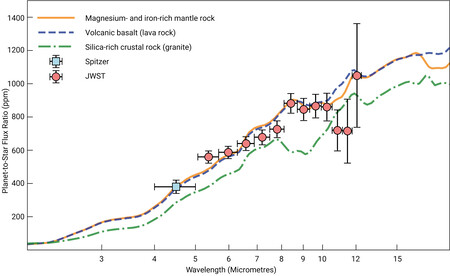
The infrared spectrum of LHS 3844b’s dayside suggests composition consistent with mantle or volcanic rock, contradicting an Earth-like crust. Credit: Sebastian Zieba et al./MPIA
Differentiating Surface Features
During 2023 and 2024, two eclipses were observed, allowing for detailed analyses of LHS 3844b’s infrared emissions. This data was compared with known celestial bodies like Earth, Mars, and the Moon. Notably, the findings indicated that LHS 3844b likely has a surface completely different from Earth, hinting at a resemblance to lunar basalt formations.
Challenging Existing Hypotheses
Initial hypotheses suggested LHS 3844b could be a young planet with active volcanic processes. However, the absence of detected gases such as carbon dioxide or sulfur dioxide challenges this notion. An alternative theory proposes that its surface is covered in a dark, fine-grained layer formed by meteoritic impacts and radiation, akin to the surface of Mercury or the Moon—a phenomenon known as space weathering.
The Road Ahead
Scientists remain optimistic that JWST will continue to provide more data to confirm these hypotheses about LHS 3844b. The achievements of this advanced telescope seem limitless, paving the way for future explorations of distant exoplanets and revealing the intricate details of their surfaces.