
The End of Affordable Housing Alternatives Around Madrid
For years, Madrid’s skyrocketing housing prices forced countless residents to seek refuge in its metropolitan area. Towns like Alcobendas, Coslada, Leganés, and Móstoles provided accessible options for those who found the capital’s real estate market unattainable. However, this once-reliable escape is now becoming increasingly limited.
Where to Buy a House?
The question of where to purchase a home used to have clear answers rooted in proximity to family, work, or community ties. Yet, as housing prices in Madrid and other major cities continue to climb, the margins for affordable options in nearby suburbs are shrinking. This shift is pushing potential buyers to consider locations further afield, redefining what it means to “afford” housing.
Teleworking and Long-Distance Moves
Thanks to teleworking and improved public transport, many are now willing to move long distances while maintaining their jobs in Madrid. For example, Valladolid has observed a demographic shift with an influx of residents from Madrid, drawn by its more favorable housing market. Despite being nearly 200 kilometers away, the AVE allows for rapid commuting, making this option increasingly viable.
Are These New Areas Still Viable Solutions?
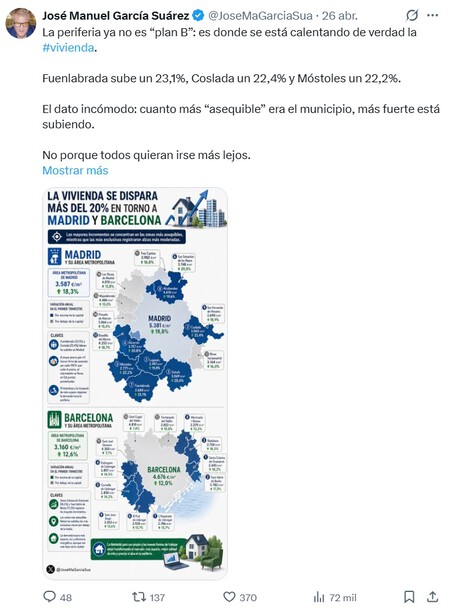
According to recent observations, while the housing market in these suburbs remains cheaper than in Madrid, the gap is closing quickly. The once-affordable markets are rising in price significantly, leading to the crucial question: how long will these areas remain a viable alternative? Many towns are already experiencing an unprecedented uptick in prices, undermining their status as “sanctuaries” from the capital’s expensive market.
The Data Behind the Price Surge
Real estate data from Idealista reveals a startling trend. As of the latest figures, the average price per square meter in Madrid stands at €5,960. While cities situated in the outskirts still offer lower prices, the growth rates in these areas are outpacing those in the capital, with places like Pozuelo de Alcorcón seeing a 16% increase and Majadahonda hitting a staggering 19.8%.
Population | Price (March 2026) | Quarterly Variation | Annual Variation |
|---|---|---|---|
Madrid | €5,960/m2 | +2.4% | +12% |
Alcobendas | €3,962/m2 | +3.5% | +19.3% |
Mostoles | €2,924/m2 | +4.5% | +20.6% |
Leganes | €3,120/m2 | +2.1% | +20.2% |
The Bigger Picture
This heating of the real estate market is not solely confined to Madrid; similar trends are evident in Barcelona as well. Suburbs like Badalona and Santa Coloma are experiencing rapid price increases, further complicating the search for affordable housing.
Future Outlook
The current trajectory of housing prices in both Madrid and Barcelona indicates a persistent challenge for potential homeowners. With ongoing construction failing to keep pace with demand, a shortage of affordable options looms. Instead of a temporary squeeze, this scenario signals a long-term shift in the living landscape, rendering peripheries less reliable as housing alternatives.
As more professionals shift to remote work and public transportation continues to improve, the attractiveness of distant areas will persist. However, if trends hold, these new choices may soon reflect the very pricing pressures people aimed to escape.
In conclusion, while options for affordable housing exist outside Madrid, their feasibility is dwindling. Potential homebuyers must act swiftly before these refuge areas become as financially burdensome as the capital itself.