
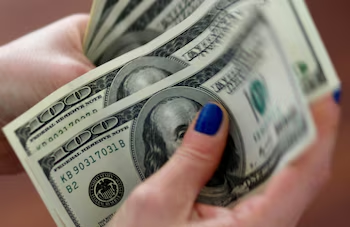
Overview of the Dollar’s Performance
In the first quarter of the year, the dollar experienced significant volatility, finishing down 4.4% against the peso. This trend continued into April, where the wholesale dollar registered a minor drop of 50 cents, settling at 1,391 pesos. The first quarter saw a decrease of 64 pesos, emphasizing the dollar’s struggle amidst economic shifts.
Factors Contributing to Dollar Weakness
The loss of purchasing power is particularly noteworthy. With inflation hovering around 12%, the real purchasing power of the dollar has diminished by approximately 16% in the local market. This decline underscores perceptions of the dollar as a poor investment in the current economic climate.
Economist Gustavo Ber notes that excess supply in the market, combined with reduced participation from the Central Bank (BCRA), is driving the dollar’s depreciation. Despite some stabilization in financial assets, the threat of the dollar dropping below 1,380 pesos looms due to continuous market adjustments.
Exchange Rate Dynamics
The BCRA has implemented a mobile exchange scheme, setting a ceiling for exchange bands at $1,703.22. This has capped the wholesale dollar at 22.4% of that limit, suggesting a controlled environment for foreign exchange operations. Analysts, including Ignacio Morales of Wise Capital, indicate that the market perceives the dollar as relatively stable in the short term, despite minor daily fluctuations.
Public Dollar Trends
The dollar for public trade recently dropped by five pesos, reaching 1,410 pesos. In April, this marked only a slight increase from March, where it was 1,405 pesos. Notably, the blue dollar—the informal market price—fell 15 pesos to 1,400 pesos, reflecting an 8.5% drop in the first quarter.
Future Outlook
The BCRA’s strategy involves purchasing currencies to bolster international reserves, having accumulated nearly $7 billion in 2023. Analysts from Max Capital highlight that daily purchases of foreign currency have remained above the reference levels, which may indicate a sustained effort to stabilize the market.
Despite these efforts, economic sentiment remains cautious. Juan Manuel Franco from SBS Group points to various market stresses and social indicators that could influence future trajectories for the dollar. The delicate balance between maintaining stability and responding to economic pressures will be crucial in the coming months.
Conclusion
In summary, the first quarter of 2026 has proven challenging for the dollar, which ended below 1,400 pesos. With an overarching theme of instability driven by inflation and market supply dynamics, the outlook remains uncertain. Investors and analysts will closely monitor the BCRA’s actions and market responses as they navigate through these evolving economic landscapes.