

Exploring Wuhu: A Glimpse into Local Life
Wuhu has turned out to be quite a surprise. While Beijing captures the essence of a bustling capital, Wuhu feels more like “neighborhood China.” The city is dotted with multi-hundred-story buildings that accommodate hundreds of families, and the atmosphere here is markedly different.
Restaurants, small shops, and local eateries create a vibrant and authentic environment. This is where Chery, the technological partner of the Spanish company Ebro, was born and has its headquarters. The impact of Chery’s presence is evident in Wuhu; it’s not just that our hotel belongs to the company, but the roads are alive with Chery vehicles.
Chery’s Dominance in Wuhu
A walk through Wuhu | Image: Xataka
If you didn’t spot a single Chery car in Beijing, you’ll notice their omnipresence in Wuhu. Taxis are all Chery, personal vehicles belong mainly to the Tiggo and Arizzo ranges, and though BYD, Geely, Toyota, Kia, and Hyundai also ply the roads, Chery’s dominance is unmatched.
This focus on local products appears to be a point of pride for residents, reflecting a national trend that favors domestic brands. It’s this sentiment that drives consumers towards Chery, much like the pride one feels when using a locally-made smartphone.
The Electric Future: Ebro’s New Model
While the focus on Chery is fascinating, today we pivot to Ebro. Underpinning Ebro’s designs is Chery’s technology, particularly with the release of an all-new electric vehicle (EV) based on the Chery QQ3 EV. This marks Ebro’s first venture into fully electric cars, set to be produced in its Barcelona factory.
The model is yet unnamed but promises features that speak to urban lifestyles. Compact and aimed at younger drivers, this model measures 4.3 meters in length, embodying a departure from Ebro’s previous SUV-centric offerings.
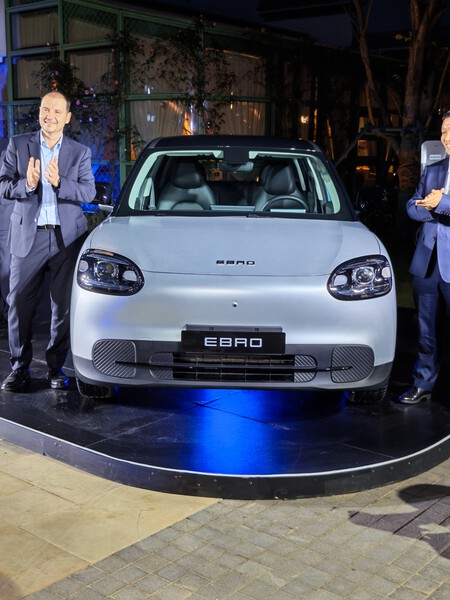
The new electric Ebro | Image: Xataka
Specifications
The Ebro EV will house a 42.7 kWh lithium-ferrophosphate battery, offering a range of over 300 kilometers. It boasts a 90 kW rear axle motor, translating to 122 HP and a maximum torque of 111 Nm, alongside achieving speeds of 135 km/h. Impressively, it can accelerate from zero to 100 km/h in under 11 seconds.
While the charging system’s power details are still under wraps, it will support both AC and DC charging, capable of juicing up from 30% to 80% in just 30 minutes.
In-Cabin Technology
Inside, the car is equipped with a 15.6-inch central screen and a 10.25-inch instrument panel. The tech features are robust, powered by a Snapdragon chip, sidelining outdated analog instrumentation for a modern digital experience.
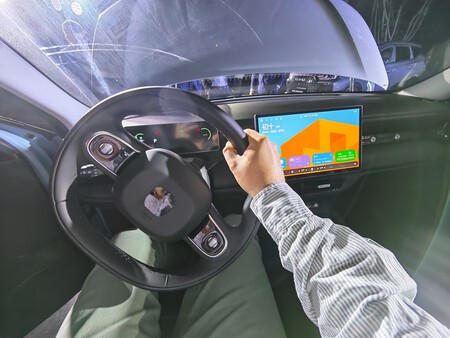
Interior of the Ebro BEV | Image: Xataka
The Crash Test Experience
A highlight of the day was witnessing a crash test—an experience that brought an unusual mix of excitement and apprehension as cars collided under controlled conditions. For this test, a Chery Tiggo 9 was positioned for a head-on collision with a Tiggo 7, along with a barrier impact.
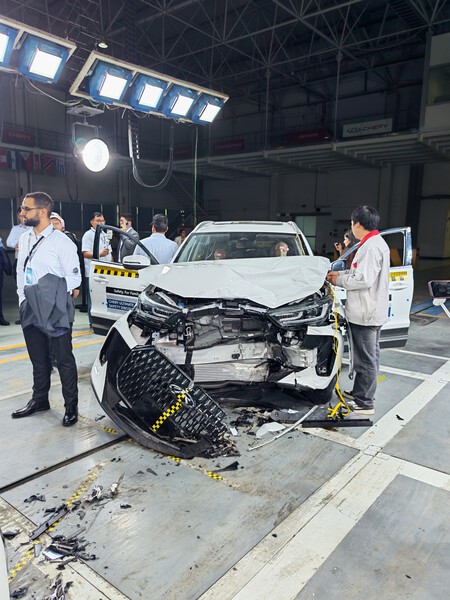
New car for sale, few kilometers, one owner, always in a garage | Image: Xataka
Results and Safety Insights
Both vehicles were visibly damaged yet intriguing results emerged; the interiors remained surprisingly intact. Functional door handles, deployed airbags, and operational lights highlighted advances in safety. This demonstration aims to shed light on the quality and safety of Chinese automotive engineering, countering prevailing prejudices in the market.
Conclusion
As Ebro moves into the electric vehicle market, the blend of local pride and innovative engineering promises an exciting future. With more previews and advancements on the horizon, it’s a thrilling time for the automotive landscape in China.