
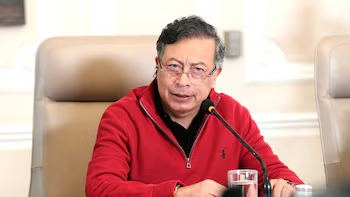
Petro’s Warning to the Bank of the Republic: Implications for the Minimum Wage
During a recent Council of Ministers meeting, President Gustavo Petro issued a stark warning to the Bank of the Republic regarding the rising interest rates, signaling a potential increase in the minimum wage as a countermeasure. This statement reframes the ongoing economic discussions in Colombia, as the president challenges the current monetary policies.
The President’s Concerns
Petro openly criticized the central bank’s Board of Directors, suggesting they are under the influence of Uribism, and expressed that further interest rate hikes would compel the government to raise the minimum wage. He emphasized, “If they raise the interest rate more, we protect more… if the board continues that nonsense, then we raise the salary again.” This fiery rhetoric marks a significant shift in the dialogue between the government and the central bank.
The president cited the principle of a “living and mobile wage,” asserting that wage increases do not contribute to inflation. Instead, he argued that the government should actively protect citizens’ purchasing power against costly credit and limited financial access.
Economic Context and Inflation
Petro’s warnings coincided with the rising inflation in Colombia, recently documented by DANE. He attributed the inflation increase primarily to external factors and speculative practices, rather than domestic structural weaknesses. Specifically, he pointed fingers at Enel, accusing the company of contributing to rising energy prices and directly affecting inflation.
Furthermore, Petro extended his remarks to focus on the government’s challenges, as the central bank has implemented a tightening monetary policy through increased interest rates. The goal of this approach is to mitigate inflation, but it may inadvertently elevate the costs of credit and hinder economic growth, prompting concerns from the government regarding its social ramifications.
Responses from Financial Authorities
Aligning with Petro’s perspective, Minister of Finance Germán Ávila accentuated the negative implications of the rising reference rate, currently at 11.25%. He warned that such a tightening of monetary policy could curtail economic growth, inflate the unemployment rate, and potentially result in the loss of approximately 48,000 jobs. The ministry highlighted how each rate increase impacts employment, further cascading into the daily lives of citizens.
The Clash of Economic Strategies
The ongoing debates about the independence of the central bank have reignited, particularly as the government’s strategy appears to counteract the traditional measures aimed at controlling inflation. While the central bank emphasizes maintaining price stability, Petro’s government calls for policies that sustain citizens’ incomes and bolster economic growth.
Future Implications
The president’s assertion that a further minimum wage increase may be necessary depending on how interest rates fluctuate adds an additional layer of complexity to the Colombian economic landscape. Such potential policies could indeed influence aspects like employment, investment strategies, and the overall cost of living in the nation.
Conclusion
As both the government and the Bank of the Republic navigate these pressing issues, the decisions made in the coming months will critically shape Colombia’s economic future. The interplay of monetary policy and social strategies raises questions about the balance between inflation control and protecting citizens’ livelihoods, an essential debate as Colombia strives towards sustainable economic growth.