
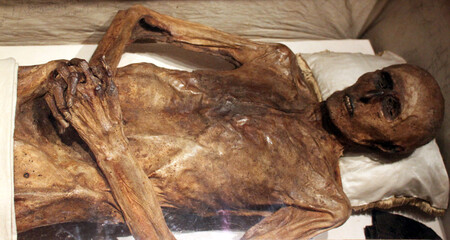
Unveiling the Mystery of Christian Friedrich von Kahlbutz
Within the crypt of a quaint rural church in Kampehl, Brandenburg, lies one of Europe’s most intriguing corpses: that of Christian Friedrich von Kahlbutz. This 17th-century nobleman, who passed away in 1702, has mystified scholars for over three centuries due to the exceptional preservation of his remains, which have naturally mummified without any embalming procedures.
The Discovery of a Lifeless Legend
The year 1794 marked a significant moment in history when workers renovating the Kampehl church stumbled upon the family crypt. Expecting to find relics of the deceased, they uncovered three coffins. To their astonishment, two of these contained fully decomposed remains, while the third housed the remarkably intact body of von Kahlbutz. His skin resembled leather, and his facial features were still identifiable, along with traces of his burial attire.
An Eerie Presence
Identifying the mummified noble was no simple feat, as the coffin lacked a nameplate. Fortunately, the initials found on his shroud provided a breakthrough, confirming his identity as the nobleman Christian Friedrich von Kahlbutz. Over time, however, the corpse became stripped of its clothing through desecrations, granting him the nickname “the naked knight.”
A Life Shrouded in Intrigue
The life of Christian Friedrich von Kahlbutz is as fascinating as his preserved remains. While referred to as a knight, von Kahlbutz held the lesser military rank of cornet. He participated in the historic Battle of Fehrbellin, claiming victory despite a debilitating knee injury. This conquest led to his acquisition of the lordship of Kampehl, where he fathered numerous legitimate and illegitimate children, partly due to his exercise of the “right of stay.”
A Tale of Allegations and a Divine Oath
In 1690, a servant alleged that he murdered her fiancé, Pastor Pickert, after being denied the right to stay. Legends suggest that during his trial, he swore an oath declaring, “If I am the murderer, may God ensure that my corpse never rots.” The absence of original trial records casts doubt on the validity of this claim, further complicating von Kahlbutz’s already enigmatic legacy.
Exploring Natural Embalming Theories
Several theories have emerged to explain the natural mummification of von Kahlbutz:
- Mummification by Healing: One major hypothesis suggests that the exceptionally crafted coffin, made of double oak and elevated on legs, facilitated airflow that dried the body, arresting decomposition. A well-ventilated crypt and an airtight seal likely contributed to this phenomenon.
- Toxic Substances: Another theory posits that the nobleman might have ingested toxic materials common in his era, like arsenic or mercury, which could have hindered decomposition while also poisoning him slowly.
- Soil Conditions: The dry, sandy conditions of the crypt’s subsoil may have also played a role in moisture extraction, aiding in his preservation.
Challenges in Unraveling the Mystery
Despite extensive studies, including recent DNA analyses and CT scans, many questions remain unanswered about Christian Friedrich von Kahlbutz’s identity and cause of death. While a CT scan in 1983 revealed no evidence of the knee injury he allegedly suffered, subsequent investigations in 2024 have yet to confirm the presence of tuberculosis as the cause of death. Curiously, a pencil was found lodged in his chest cavity, suggesting the corpse had been manipulated post-mortem.
In conclusion, the saga of Christian Friedrich von Kahlbutz embodies a captivating blend of history, legend, and mystery. As scholars continue their investigations, this nobleman’s remains may forever retain their secrets, offering endless fascination for generations to come.