
The Fascinating Discovery in Asturias
The recent archaeological discovery in the La Cerrosa-Lagaña cave, Asturias, has revealed a significant piece of Roman military history: the prototype of the cingulum, or belt, worn by Roman legionaries. This breakthrough brings to light how Rome incorporated and adapted elements from conquered cultures, showcasing its innovative military evolution during the Asturian-Cantabrian wars (29-19 BC).
The Importance of Cultural Assimilation
The Roman Empire, at its zenith, was not merely a product of its military supremacy; it thrived on the ability to absorb and refine technologies from various cultures throughout its expansion across three continents. This cultural transfer molded the Roman legions from a citizen militia into a highly professionalized and standardized military force. The newly discovered bronze belt, with its intricate design, stands testament to this phenomenon.
Key Elements of the Discovery
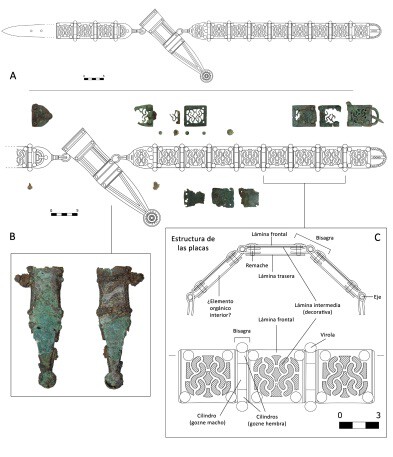
The excavation revealed several artifacts, including a dagger sheath, a bronze omega fibula, a spear, and notably, an articulated bronze belt. Comprising a buckle and four meticulously designed openwork plates, this belt was not a random find. Its advanced construction allowed for greater flexibility and rapid access to weapons—features essential in battle. The craftsmanship suggests that it originated from workshops renowned for their expertise in metalwork, likely within the Vaccean and Celtiberian communities.
The Significance of the Belt
Historically, the cingulum was seen as a quintessential symbol of Roman soldiers. However, this discovery introduces the concept of “technological hybridization.” Researchers now posit that the belt’s design was influenced by local Hispanic technologies before being standardized for Roman use. This realization challenges the notion of purely Roman military equipment and highlights the Empire’s adaptability.
Context and Ritual Significance
Interestingly, the belt and accompanying artifacts were not found in a conventional military setting but rather in a challenging cave environment, suggesting a possible ritualistic context. Some researchers theorize that the artifacts may have belonged to a subordinate foe or even a Roman captured during conflicts, placed there as offerings to Cantabrian deities amidst Roman advances.
Main Hypotheses of the Research Team
Technological Hybridization: The belt’s design indicates it was crafted in non-Roman workshops, exemplifying the melding of indigenous and Roman techniques.
Evolution as a Standard: The belt’s guards closely resemble those found in other military sites, hinting that local artisans redefined existing designs to improve functionality, which the Romans later adopted for military uniformity.
Conclusion: Unraveling the Threads of History
While questions remain about the identities of those involved in this historical tapestry, what stands clear is the belt’s pivotal role in understanding military evolution. The exploration doesn’t merely reflect a localized historical anomaly but enriches our broader knowledge of cultural interactions during Roman times. Future findings from other European sites are essential to unveil whether this process of adaptation was unique to Hispania or part of a more extensive pattern across the empire.
This revelation ultimately bridges a critical gap in military history, enriching our understanding of how technology and culture intertwined through the ages.