
The TRAPPIST-1 System: A Natural Laboratory for Planetary Evolution
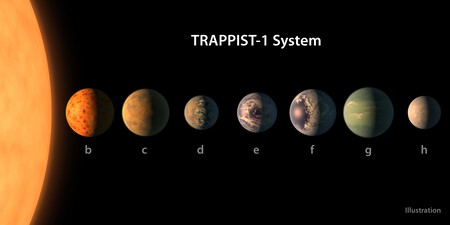
The star TRAPPIST-1 and its seven surrounding planets offer a unique opportunity for scientists to study the evolution of rocky planets. These intriguing celestial bodies capture the attention of astronomers hoping to uncover the potential for habitability beyond Earth. However, recent observations from the James Webb Space Telescope (JWST) have delivered some discouraging news regarding their atmospheres.
A Struggle for Atmosphere
The James Webb Space Telescope employs advanced infrared radiation instruments that allow researchers to analyze the temperature of distant planets. By mapping the thermal emissions, astronomers can infer vital details about these worlds. Initial studies focused on TRAPPIST-1a and TRAPPIST-1b, revealing that neither planet possesses an atmosphere. Even if they once had one, it might have been lost to the intense conditions imposed by their host star. This discovery dims the prospects of finding habitable environments within the TRAPPIST-1 system.
Understanding TRAPPIST-1’s Environment
The TRAPPIST-1 system contains seven exoplanets, all closely orbiting their parent star, a red dwarf. The orbits are confined to a distance that is comparable to the space between Mercury and the Sun. While this proximity could suggest potential for habitability, the environment around red dwarfs presents unique challenges. These stars are known for emitting high levels of radiation and energetic particle flows capable of eroding planetary atmospheres. No atmosphere equates to no life.
The Impact of Tidal Locking
All seven planets in the TRAPPIST-1 system are tidally locked to their star, meaning they rotate in a synchronized manner. As a result, one hemisphere faces the star perpetually in daylight, while the opposite hemisphere remains in night. This creates extreme temperature variations based on whether the planet has an atmosphere to redistribute heat.
NASA/JPL-Caltech
Temperature Extremes: A Barrier to Habitability
In tidally locked planets, the presence of an atmosphere plays a crucial role in temperature stability. Without an atmosphere, one side can reach scorching temperatures of 100°C to 200°C, while the other side may plummet to around -200°C. The recent findings from JWST confirm that TRAPPIST-1a and TRAPPIST-1b are devoid of an atmosphere, pushing the boundaries of habitability further out of reach.
Looking Ahead: Hope Still Exists
Despite these setbacks, there is still a glimmer of hope. The analyzed exoplanets do not lie within the star’s habitable zone—the region where conditions permit liquid water. However, TRAPPIST-1e, TRAPPIST-1f, and TRAPPIST-1g remain potential candidates for further study. Notably, TRAPPIST-1e has a density and size comparable to Earth and could still harbor an atmosphere.
The TRAPPIST-1 System and Its Significance
In conclusion, while the TRAPPIST-1 system presents challenges in the search for habitable planets, it remains a treasure trove of information regarding rocky planet evolution. The loss of atmospheres may be a setback, but investigating TRAPPIST-1e provides a pathway to understanding the conditions necessary for life. As researchers continue to explore this fascinating system, we progress step by step toward uncovering the mysteries of the universe.
Image | NASA, ESA, CSA, Joseph Olmsted (STScI)