
The Rising Threat of AI-Generated Malware: Exploring VoidLink
For years, creating sophisticated malware required significant expertise, time, and technical knowledge—an undertaking typically reserved for seasoned hackers. However, the onset of artificial intelligence (AI) is reshaping this landscape. Recent advancements have shown that AI can dramatically accelerate software development, including malicious code, leading us to consider the implications of these tools in the wrong hands.
What is VoidLink?
VoidLink, recently analyzed by Check Point, is heralded as a groundbreaking example of advanced malware developed primarily through AI assistance. Interestingly, this malware was detected in its early stages, meaning it was not yet deployed against victims or utilized in active attacks. This early recognition allowed researchers to explore developmental materials that would otherwise go unnoticed, illuminating how such malware can take shape.
How Was VoidLink Built?
VoidLink is not just a minor or rudimentary malware—it’s a sophisticated framework designed for Linux environments, equipped with a modular architecture that enables prolonged stealthy access, particularly in cloud settings. The analysis highlights notable components like eBPF and LKM rootkits, along with modules tailored for cloud enumeration and operations within container environments. This level of sophistication distinguishes VoidLink from simpler prior iterations of malware.
The Developer Behind VoidLink
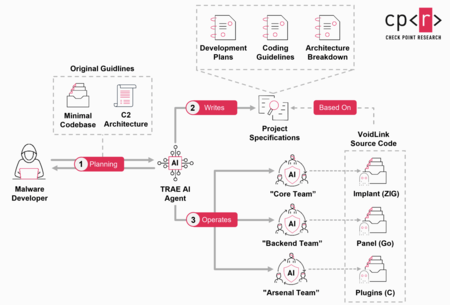
One of the most intriguing aspects of VoidLink is the nature of its creator. Initially, the malware appeared to stem from a large team of developers due to its complex internal structure. However, Check Point’s investigation revealed that it was likely the work of a single individual, who leveraged AI in various stages of development. This person is not a novice—rather, they possess a robust technical skill set and previous experience in cybersecurity.
Unique Development Methodology
The construction of VoidLink follows what Check Point terms “Spec Driven Development.” This approach consists of several key steps:
- Define Objectives: Clear specifications of what needs to be built.
- Architecture and Task Breakdown: Translating ideas into a structured framework, including tasks, sprints, and delivery parameters.
- AI Implementation: Delegating the developmental tasks to AI models.
Documents recovered during the investigation suggest that in a remarkably short time—less than a week—VoidLink had evolved into a functional prototype, boasting over 88,000 lines of code.
The Implications of AI-Generated Malware
VoidLink stands as a significant milestone in the realm of cyber threats, marking what Check Point describes as the first confirmed instance of advanced malware created predominantly with AI. This revelation raises pressing questions about the future of cyber threats and the capabilities that malicious actors can achieve using similar methods.
The intersection of AI with malware development is a chilling concept. As technology continues to evolve, so too does the potential for misuse. The growing ease of creating sophisticated malicious code using AI tools underscores the need for enhanced cybersecurity measures and vigilance across all digital platforms.
Conclusion
As we grapple with the implications of advanced AI-generated malware like VoidLink, it becomes essential for cybersecurity professionals, organizations, and governments to prepare for an increasingly complex digital landscape. The advent of such technologies not only challenges traditional defense mechanisms but also requires a proactive approach to understanding and mitigating emerging threats.