
Artemis II has secured its place in history, marking a monumental moment as Orion splashed down off the coast of San Diego, culminating a ten-day mission that brought astronauts near the Moon for the first time since 1972. This mission wasn’t just about a round trip; it validated NASA’s spacecraft, crew, and ambitious goals as the agency aims to explore deeper into space with its international partners.
Orion’s Historic Splashdown
The significant moment occurred at 8:07 p.m. EDT on April 10, corresponding to 2:07 a.m. on April 11 in Spain. This splashdown marked the end of Orion’s flight, transitioning into a meticulously planned recovery phase. A mere capsule touching the ocean represents much more—the culmination of precise maneuvers, military operations, medical assessments, and the safe extraction of the crew.
The Challenges of Re-Entry
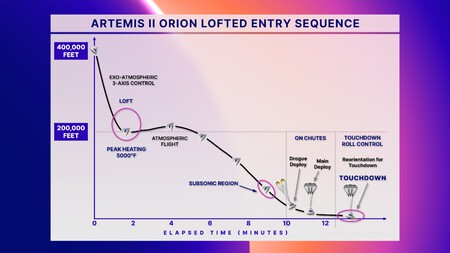
Contrary to popular belief, the most complex part of the mission wasn’t the lunar flyby—it was the return home. To ensure a safe landing, Orion had to enter the atmosphere under optimal conditions, with its heat shield exposed post-service module separation. The capsule faced intense friction, enveloped in plasma, along with a communications blackout for six minutes. NASA mentioned that, under standard conditions, the crew could endure up to 3.9 G forces. The successful navigation of this phase hinged on precise physics, engineering, and flawless timing.
Key Moments of Re-Entry
- 01:33: Service module separation and heat shield exposure (completed)
- 01:37: Final adjustment of entry path (completed)
- 01:53: Upper atmosphere re-entry and communications blackout (started)
- 02:03: Opening of drogue parachutes at high altitude (successful)
- 02:04: Deployment of three main parachutes (completed)
- 02:07: Orion splashdown off San Diego (successful)
- Before 04:07: Crew recovery and transfer to support ship (pending)
Milestone Achievements
Artemis II established several significant milestones. It was the first manned mission beyond Earth’s orbit since 1972, completing a lunar flyby without landing, while exceeding 400,000 kilometers from Earth—surpassing the record set by Apollo 13. These accomplishments underline the mission’s vast significance.
Memorable Moments
Beyond the hard facts, Artemis II offered scenes that will resonate in collective memory, such as images of the Moon’s far side and captures of a solar eclipse. A delightful surprise emerged when a jar of Nutella appeared floating during one of the live broadcasts, infusing a touch of humor to the solemnity of the mission.
Looking Ahead
As Artemis II concludes, NASA is poised to enter a demanding calendar for subsequent stages of the Artemis program. With a new mission on the horizon, the focus will be on operations that support future lunar landings. The next phase aims to refine the mission architecture with new maneuvers and various tests as we inch closer to more significant exploration.
Conclusion
In the aftermath of the landing images, parachute deployments, and recovery in the Pacific, the lasting impact of Artemis II will showcase the feasibility of returning astronauts to the lunar environment. This mission has successfully demonstrated the complex and precise nature of modern space travel.